
NTPC 7.62% Tax-Free Bonds – September 2015 Issue
This post is written by Shiv Kukreja, who is a Certified Financial Planner and runs a financial planning firm, Ojas Capital in Delhi/NCR. He can be reached at [email protected]
Volatile stock markets are again testing the nerves of Indian investors. People, who invested in stocks or equity mutual funds in the hope of some quick fixing by the Modi government, have been left disappointed with the kind of returns they have earned in the last one year or so. Some investors are headed towards safe fixed deposits where interest rates are continuously falling, while others are looking to invest in debt funds.
But, the recent problem with JP Morgan debt funds, in which the fund house restricted redemptions in two of its debt schemes – Short Term Income Fund and India Treasury Fund, has once again shaken the investors’ confidence in debt funds as well.
So, what do investors do in the current economic scenario? Stay in cash? Or invest in gilt funds and tax-free bonds only?
It is said that the best time to invest is when there is a panic. But, the problem is that it is very difficult to figure out whether the panic is based on some kind of reality or it is just a perception and a short-term phenomenon.
After a gap of one financial year, tax-free bonds are making a comeback this financial year and NTPC is the first public sector enterprise (PSE) to launch the public issue of such bonds from the coming Wednesday, September 23rd. As the company is confident of raising the desired amount very quickly, the issue will remain open for just seven working days to get closed on September 30th i.e. the next Wednesday.
Size of the Issue – NTPC has been authorized to raise Rs. 1,000 crore from tax free bonds this financial year and it has already raised Rs. 300 crore by issuing these bonds in private placement. The company will raise the remaining Rs. 700 crore from this issue.
The issue size of Rs. 700 crore is very small for a large population of investors waiting for these bonds for around 18 months now and for this reason, I think the issue should get oversubscribed on the first day itself.
Rating of the Issue – NTPC is India’s largest power generator and a ‘Maharatna’ company with market capitalization of Rs. 104,759 crore. Being a PSU with strong fundamentals and government backing, CRISIL, ICRA and CARE have assigned ‘AAA’ rating to the issue.
Moreover, these bonds are ‘Secured’ in nature and certain fixed assets of the company will be charged equivalent to the outstanding amount of the bonds.
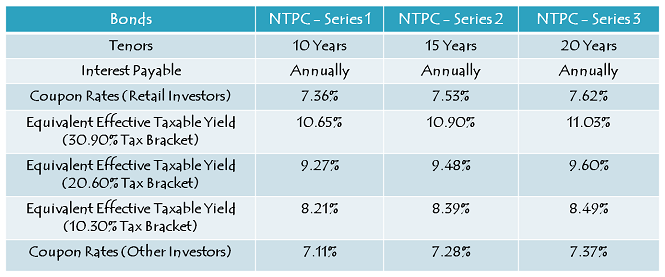
Coupon Rates on Offer – NTPC is offering yearly rate of interest of 7.36% for its 10-year option, 7.53% for the 15-year option and 7.62% for the 20-year option to the retail investors investing less than or equal to Rs. 10 lakh.
As mandated by the government, these rates would be lower by 25 basis points (or 0.25%) for the non-retail investors.
NRI Investment Allowed on Non-Repatriation Basis – Non-Resident Indians (NRIs) are also eligible to invest in this issue, but only on a non-repatriation basis. NRI investors will not be allowed to repatriate its interest amount or maturity proceeds outside India.
QFI Investment – Qualified Foreign Investors (QFIs) are not allowed to invest in this issue.
Investor Categories & Allocation Ratio – The investors have been classified in the following four categories and each category will have certain percentage of the issue size reserved during the allocation process:
Category I – Qualified Institutional Bidders (QIBs) – 10% of the issue is reserved i.e. Rs. 70 crore
Category II – Non-Institutional Investors (NIIs) – 25% of the issue is reserved i.e. Rs. 175 crore
Category III – High Net Worth Individuals including HUFs & NRIs – 25% of the issue is reserved i.e. Rs. 175 crore
Category IV – Resident Indian Individuals including HUFs & NRIs – 40% of the issue is reserved i.e. Rs. 280 crore
Allotment on First Come First Served Basis – Subject to the allocation ratio, allotment will be made on a first come first serve (FCFS) basis in each of the investor categories, based on the date of upload of each application into the electronic system of the stock exchanges.
Listing & Allotment – NTPC has decided to get these bonds listed on both the stock exchanges i.e. National Stock Exchange (NSE) as well as the Bombay Stock Exchange (BSE) and has successfully got the necessary in-principle listing approval also from these exchanges. The bonds will get allotted and listed within 12 working days from the closing date of the issue.
Demat Account Mandatory – This is one of the noticeable changes as compared to the last time. NTPC has decided to allot these bonds only in dematerialised form and thus, the investors do not have the option to apply these bonds in physical or certificate form.
So, if you want to apply for these bonds in this issue and do not have a demat account, act now as you have only two days with you to get a demat account opened. However, once allotted in demat form, the investors can rematerialise the bonds in physical/certificate form if they decide to close their demat account in future.
No Lock-In Period – These tax-free bonds are freely tradable and do not carry any lock-in period. The investors may sell them at the market price whenever they want after these bonds get listed on the BSE or NSE.
Interest on Application Money & Refund – Successful allottees will earn interest at the applicable coupon rates on their application money, from the date of realization of application money up to one day prior to the deemed date of allotment. Unsuccessful allottees will get interest @ 5% per annum on their refund money.
Minimum & Maximum Investment – Investors are required to put in a minimum investment of Rs. 5,000 in this issue i.e. at least 5 bonds of face value Rs. 1,000 each. There is no upper limit for the investors to invest in this issue. However, an investor investing more than Rs. 10 lakhs will be categorized as a high networth individual (HNI) and will get a lower rate of interest as applicable.
Interest Payment Date – NTPC will make its first interest payment exactly one year after the deemed date of allotment and the deemed date of allotment will be announced just before the listing date. I will update this post as and when it gets announced.
Fundamentally, NTPC is a good company, ranked nineteenth among the top Indian companies by market capitalization. Also, at present, there are only seven central public sector enterprises (CPSEs) which have been conferred the status of Maharatna and NTPC is one of them.
Among the seven companies which have been authorized to issue tax free bonds this financial year, NTPC is the only company which has the ‘Maharatna’ status.
Should you invest in this issue?
There are many reasons why I think yield on government securities (G-Secs) should fall here in India. China slowdown, no rate cut by the US Federal Reserve on September 17 and falling WPI & CPI inflation – I think all these factors would make the RBI governor Dr. Rajan to think about cutting policy rates in its monetary policy scheduled to be held on September 29th. But, less than normal rainfall and less than desired improvement in the Indian economy & fiscal deficit, are a couple of reasons which might not work in favour of a rate cut.
Moreover, Congress playing spoilsport in the passage of important bills like GST and the land acquisition bill are also putting pressure on the Indian economy and thus making it extremely difficult for the Modi government to take further actions on the reforms front. RBI is keeping a close eye on the steps taken by the government to strengthen the economy and revive the investment sentiment.
If all goes well and the government is able to implement GST from April 1 and the land acquisition bill after the Bihar elections, I think India would replace China to become the most attractive investment destination for the global institutional investors.
Personally, I feel there is a good scope of 50 basis points (0.50%) rate cut by the RBI in the next 6-9 months and as a result, the 10-year G-Sec yield should fall below 7% by April-June next year. If that materialises, then there would be at least 8-10% appreciation in the market price of these bonds by the end of current financial year.
Application Form of NTPC Tax Free Bonds
Note: As per SEBI guidelines, ‘Bidding’ is mandatory before banking the application form, else the application is liable to get rejected. For bidding of your application, any further info or to invest in NTPC tax-free bonds, you can contact me at +919811797407
Happy to see Tax Free Bonds are back in the market. 🙂
Thanks Shiv for sharing.
Hi Amlan,
Yes, many retail/HNI investors were waiting for these bonds to get issued. These bonds were badly missed by us last year when the interest rates were high. I hope the investors have healthy returns from these issues as well! 🙂
Dear Shiv – Thanks much for this post. I am planning to invest substantial amount in the coming tax free bonds and have been waiting with the funds in my savings account. (Do not want to take risk with liquid funds). I planned to invest x/4 amount in NTPC, x/4 amount in NHAI and x/2 amount in IRFC. I already hold tax free bonds from REC, PFC and am worried about the conditions of the state electricity boards and so would like to avoid these two.
In this respect, would it be better to invest max allowed retail limit in NTPC since we are not sure when the other two issues will come and the rates might go .25% down in the interim. Or is it sensible to diversify with multiple issuers. Or should we invest in NTPC now and sell the proportionate amount and switch when the other two issues come. (This assumes there is liquid market and 0.15% brokerage fees and taxes on gains) What would you have done, No onus on you. Many thanks.
I have the same query! thanks for covering it.
Hi Reader,
I completely agree with Shirish’s views here. Moreover, I think it makes sense to invest to the maximum extent in NTPC as I think it will get oversubscribed at least 2 times in the retail category on the first day itself. So, you’ll not get the full allotment. Remaining money you can diversify in the other two issues.
I think rate cut or no rate cut, G-Sec yield won’t change much on or after September 29th. It is the China effect and GST, Land Acquisition Bill, Reforms, Bihar Elections etc. which would be playing major role in the G-Sec yield movement going forward. Trajectory is biased towards a downward momentum though.
If i were in your place, I would invest maximum possible (10L or 10+10 L with spouse) for following reasons:
1. interest rates would go down from now on over next 1-2 years and one cut could before Dec-15. Other PSUs would wait for rate cut before issuing TFB.
2. NTPC is as safe as any other PSU navratna which is a highest rated PSU. So diversification is not necessary. Default by NTPC is extremely rare and if it happens, it would be a watershed event, so most unlikely.
3. Selling immediately on listing or immediately after interest rate cut, does not make sense. Investment in TFB should be for long term in falling interest rate environment.
Happy intesting..
Thanks makes sense. I do not hold or plan to buy NTPC equity shares so it would be ok to invest maximum in the tax free bonds.
Thanks Shirish for your inputs!
What is the point in locking money for such duration at low interest rates. Even if rates fall further but still secondary market bonds offer good opportunity to investors.
Agree Ajay. It is an important point to be taken in account. The interest rate is currently low and likely to further go down. If it further go down , you will benefit provided you sell in the secondary market for the premium. Holding long term is left to the individual based on cashflow one is looking for. Interest rate is cyclical and we may have high interest rate in future. But if you are in 30% tax bracket, anytime the Tax free return that you will get from this bond is better. You should not look for the price of the bond in the market at that time and hold until maturity or when you can trade in profit.
Thanks George for your inputs!
Hi Ajay,
Most of the listed tax-free bonds are trading on the stock exchanges at a yield (YTM) lower than the coupon NTPC is offering. So, I think it makes sense to apply for tax-free bonds in such issues.
Hello Shiv,
I have heard about this YTM concept and that it helps in comparing the bonds and to decide whether one should invest in a bond or not. Could you please do a follow up post on YTM, what exactly does it mean and how to calculate/use this for our advantage.
As always, thank you for doing the good work that you and Manshu are doing via this web site.
Cheers
Very Nice and Helpful Post
Thanks Finance Blog!
Interest rate is low? With global deflation, I think interest rates in India will fall further if our inflation is under control.
I agree!
Sir
Do you have any idea of PFC bonds plan and its interest rates. PFC have filed its DHRP.
Regards
Piyush
Hi Piyush,
PFC has not announced its coupon rates as yet, but the issue is expected to open in September itself.
Its better to invest in NTPC tax free bonds that its shares.
I think NTPC is a good company and stock investment is always a high risk-high reward proposition. I think its shares are very attractively valued and should provide better returns than these bonds.
Thanks to BJP govt after approving such attractive scheme which is guaranteed for Small investor for long term without any puzzle having AAA Rating of PSU.We should adopt such guaranteed Return bonds which is appearing after 2 years.
Dear Mr. SHIV KUKREJA,
For retail investor, how difficult it is to trade tax free bonds in the secondary market ? Any idea about the volume of such bonds being traded in the secondary market. Where to find the info regarding trade volume of these bonds.
Hi Nawraj,
I think liquidity is good enough for a retail investor to liquidate his/her holdings at a short notice. But, he/she might get a price which is Rs. 5-10 lower than the market price i.e. a discount of Rs. 0.5-1% to the market price. Otherwise, I don’t think there is any liquidity crisis as such in tax-free bonds. The better the company is, more will be the demand for its tax-free bonds. Here you have the link to check the trading data on a daily basis – http://www.nseindia.com/live_market/dynaContent/live_watch/equities_stock_watch.htm?cat=SEC
Please check this link of NHB 9.01% tax-free bonds – http://www.nseindia.com/live_market/dynaContent/live_watch/get_quote/GetQuote.jsp?symbol=NHBTF2014&series=N6
212 bonds of NHB got traded today on the NSE with a value of Rs. 1.315 crore. Market price is Rs. 6205, a couple of buyers are willing to buy 20 bonds at around Rs. 6200 and a couple of sellers are willing to sell their 20 bonds at around Rs. 6210. So, it is a game of demand and supply. Higher the demand is, higher will be the market price and it will be easier for the sellers to sell their holdings.
Very good article Shiv!!
Thanks Anubhav! 🙂
Sir,
I wants the ntpc bond so how could Buy me it
Hi Jagdish,
To invest in NTPC tax-free bonds, you need to have a demat account. If you have a demat account, then you can either invest in it through your broker OR you can download the form from the link pasted in the post above & contact me on 09811797407 to do the bidding of your application. After the bidding is done, I’ll let you know your Exchange Bid Id, get your application collected from your place and submit it at the designated collection centre.
Thanks a lot Shiv for this post on TFB
For any information related to Tax Free bonds, I always rely on your posts as I find all the relevant information which enables me to take the decision. Thanks once again.
Thanks a lot Mr. Singh for your kind and motivating words !! 🙂
I am not sure if tax free bonds issues this year will be a big hit like 2013. NTPC issue will sail through easily as issue size is small. Rest of the issues will face challenge especially when G-sec continues to fall. Interest rates for TFB are quite low compared to previous years. Most of the HNI’s would have stocked up enough TFB from previous issues. Long term gilt funds will offer a better play for interest rate cut scenario than tax free bonds. 1.3% interest differential with PPF is another dampener. Let us see how first day subscription looks for NTPC TFB and that will give us a trend for future issues
I agree with you Ramadas! After all, tax-free bonds with 8.75% to 9.01% rate of interest were quite attractive in 2013. But, I think only NHAI will struggle to raise Rs. 16,800 from these issues, rest should sail through comfortably. Those investors who missed out on the previous issues will invest this time around. First day trend will be very interesting to observe. Moreover, PFC has just announced the coupon rates for its forthcoming issue. PFC’s rates are marginally lower than the rates offered by NTPC. So, investors will be attracted more towards the NTPC issue.
PFC tax-free bonds issue update – Issue opens 5th October, closes 9th October. Issue size Rs. 700 crore. Interest Rates for Retail Individual Investors investing upto Rs. 10 lacs:
10 years – 7.36% p.a.
15 years – 7.52% p.a.
20 years – 7.60% p.a.
Demat account is NOT mandatory for the PFC issue.
Thanks Shiv once again for the information, I just applied for this issue. Although interest rates are quite low than last year but I believe this is still a better option compared to marginally high Bank Fd’s. Let’s see how the overall response is. Btw I am still holding very substantial qty of last year’s TFB’s which are trading at 15 to 20% premium. Do you think I should sell them now and book profit or wait further for interest rates to fall. Regards
Thanks Ikjot!
I agree, these bonds are way better than bank FDs. Moreover, I have recommended my family members to hold on to their holdings as I think interest rates should fall further from here. It is up to you what your view is about the interest rates and economic growth.
I am also thinking of switching into new bonds with following considerations –
1) Diversification
2) With indexation, I believe any capital gain upto 15% is tax free ! ( 2013-14 Index being “939” and this year it is “1081” )
3) Any holdings in 15 year series then, can be switched into 20 years now, for additional 7 yrs
Hi Sagar,
Point No. 2 – It is 10% flat capital gain tax on listed bonds after 1 year of holding. Indexation benefit doesn’t apply here.
Sir, what is bidding. My agent has asked me to fill up the form and attach a cheque and handover the same to him. Will I not get the bonds?
Hi Sveety,
Your agent will do the bidding on the stock exchange before banking your application. So, the process is the same.
The issue is already oversubscribed 1.22 times by noon for retain category IV.
http://www.nseindia.com/products/content/equities/ipos/debt_ipo_current_ntpctfb15.htm
All retail investors are definitely not going to get full allotment. Still 3 hours to go for day 1.
Hi Parthiv,
I think only 15-20% allotment will be made to the retail investors. Still more than one hour to go.
Yeah Shiv, but on NSE website they have put the NCDs offered as 40,00,000 only, whereas it should be 70,00,000.. right? I mean they have kept the option open to retain over subscription upto 300 crores.
So, even though it shows 0versubscribed by 1.64 times as of now, wouldn’t retain investor still have chance to get full allotment, as compared to 28,00,000 NCDs (280 crores) for retain investors, as of now 26,25,705 NCD bids have come in this category.
Thanks for your wonderful insights, as always.
Hi Shiv,
Your estimation on allocation is correct. It will be around 20-22% for retail which oversubscribed 4.62 times.
Based on 11x oversubscription for retail , allotment will be around 9% only. I guess awareness of TFB has gone up substantially in last 1.5 years. Cant explain anything else for this much euphoria for a fixed income instrument.
Ramdas, 11X for 400 Crores and complete 100%. NTPC can go upto 700 Crores. There is 40% reserved for Retail investors out of 700 Crore. This 40% retail will have 280 crores. The subscription for retail is 6.6 times. Mostly the allocation will be around 14-15%.
Allocation would be between 15-16%.
Thank you Shiv for this post ! Can you please help me in understanding following points..
1. What is the point in investing this TF bond at about 7.5 % while the debt MF schemes available in market are offering about 9 % and after paying taxes using indexation mechanism one can earn more than 7.5 %.
2. How about if someone buys higher interest TF bond from secondary market with a premium, just wanted to understand what else someone has to pay apart from premium ?
3. If some one buys TFB from the secondary market then he gets the same interest as originally offered by TF bond or its less by 1% ?
4. Who will earn the TFB interest if someone buys it in the middle of the year, is this buyer or seller ?
Thank again,
Hi Krishna,
1. Mutual Funds do not assure returns. I don’t know which mutual fund scheme you are talking about. Debt mutual funds invest in these kind of bonds/NCDs only.
2. It is advisable to compare listed tax-free bonds’ yield (YTM) with coupons of current tax-free bonds. Whichever is higher, net of charges, should be bought.
3. Original rate of interest will be paid, subject to an investment limit of Rs. 10 lakhs.
4. Buyer will get the interest payment, seller will get the premium which the listed bond would be carrying.
Shiv, I think Krishna is referring to Gilt funds. Considering the Govt bonds are trading at average 7.8% interest, he is suggesting 7.5% return from these bonds. If interest rate goes down the return of these bonds will be higher. Though we cannot compare TF bonds with these funds, if we are looking at low interest rates, these debt funds will give return above 8% if invested now. But to avail tax benefit by indexation one will have to hold them for minimum 3 years. Both products have advantage and disadvantages and one will have to take this decision based on the requirement.
Thanks Shiv & George !
1. I was talking about ultra short term MF like ICICI Prudential Flexible Income Plan, they are not guaranteed but generally they give 9% return and after indexation we will get about more than 7.5% tax free.
2. Regarding point no 4 above, in that case do you mean to say that the premium amount gets reduced every time when the interest is paid ? As the interest is already paid to seller and now the buyer has to wait for complete one year.
Thanks !
Hi Krishna,
1. Check the portfolio of ICICI Pru Flexible Income Plan – https://www.valueresearchonline.com/funds/portfoliovr.asp?schemecode=10467. It has also invested in bonds/NCDs of corporates & PSEs. In a falling interest rate scenario, I think income funds like this one should give superior returns than tax-free bonds and in a rising interest rate scenario, such funds would perform poorly as compared to tax-free bonds. There is no historical evidence with me though to prove this point.
2. Yes, that’s correct. On the Ex-Interest Date, market price of these bonds fall by 7-9% as against their previous closing price.
Hi George,
In the last two years or so, I think tax-free bonds and Gilt funds must have given similar returns i.e. +/- 2%. But, still you are right, each of these products has its own advantages & disadvantages.
I agree with you Shiv. Those who purchased TF bonds last time got better deal than any other fund investment. But considering the low yield offered by the current issues, the rush is not justified. I will consider the following reasons.
1. People were waiting eagerly and those who heard about the benefit reaped by previous investors were just waiting for an opportunity.
2. Last times, most of the issues came 2 issues at a time and the amt was also in few 1000 crores.
3. NTPC is having only this issue and NTPC is considered as one of the favorites in the lot.
4. This is initial rush and not likely to substain as we have seen in 2012-2013 where yield offered was between 6.8 to 7.5. Those who invested in those bonds repented when 2013-14 bonds came.
Regarding Krishna’s argument of 9% from some Debt MF, one should be cautious and look at which bonds those funds invested. If it is with rating less than AA-, Amtek default should be an eye opener for such investors investing directly low rated bonds or fund which have investment in such funds.
Hi George,
I agree with all the points you made above. One more thing – the methodology for calculating & fixing coupon rates on these bonds has remain unchanged from the last time in 2013-14. So, I think the coupon rates are moving in tandem with our G-Sec yield. So, these rates are equally attractive or unattractive to me. Only noticeable difference is the rate of inflation & sentiment around the government policies.
In 2013-14, there was a panic with US Fed announcing its decision to hike its policy rates. US treasury yield spiked up very sharply, creating a panic among the global investors with Indian G-Sec yield rising from a low of 7.20% to 9%+. Situation has not changed dramatically on the global front, but inflation has cooled down here and there is investors’ confidence in the government policies now.
Thank you to both of you ! It helped me. Can you please share some attractive gilt fund names ?
Thanks,
I Suggest SBI Long term Gilt fund or HDFC High interest and Dynamic fund. Look at investing in direct funds.
Thank you George !
Wow 11.55 times subscription in retail !!
In 2013, I applied for most of the TFBs with 100% allocation, in most cases I applied on 2nd or 3rd day looking at the daily subscription figures ! Can’t do that anymore !
Hi Sagar,
Bidders are giving competition to each other now. Number of applicants have gone up significantly.
Day 1 (September 23) subscription figures:
Category I – Rs. 212.50 crore as against Rs. 70 crore reserved – 3.04 times
Category II – Rs. 1416.11 crore as against Rs. 175 crore reserved – 8.09 times
Category III – Rs. 940.76 crore as against Rs. 175 crore reserved – 5.38 times
Category IV – Rs. 1848.21 crore as against Rs. 280 crore reserved – 6.60 times
Total Subscription – Rs. 4417.58 crore as against total issue size of Rs. 700 crore
Extraordinary appetite for tax-free bonds. No point applying for the bonds tomorrow onwards. It is better to wait & apply for the PFC issue now.
Major concern is on refund. If it is delayed, the investors will find difficulty in applying for next issue.
Hi George,
Investors won’t get refund before the next issue opens on October 5th as there are two public holidays coming in between, Eid tomorrow and Gandhi Jayanti on 2nd.
Dear Shiv,
Regarding – Allocation would be between 15-16%.
Is the allocation on proportion basis. What does first come first served basis allotment mean? I applied through sharekhan at 9 am yesterday for full retail limit. Any chance I’ll get full allotment.
thanks.
ok i read the draft prospectus and understand it now.
“In case of over-subscription, Allotments to the maximum extent possible, will be made on a first-comefirst-serve
basis and thereafter on a proportionate basis in each Portion, determined based on the date of
upload of each Application into the electronic system of the Stock Exchanges, meaning full Allotment of
Bonds to the Applicants on a first-come-first-serve basis up to the date falling one day prior to the date
of over-subscription and proportionate Allotment of Bonds to the Applicants on the date of oversubscription”
Yes, the day the issue gets oversubscribed, proportionate allotment is made to all the bids made on that day.
Dear Shiv,
Will a person who has applied for only 10 or 20 bonds on the first day, get confirmed proportionate allotment of 2 or 3 bonds ? Or is the minimum allotment quantity fixed at 5 bonds, which was the minimum application quantity ?
Thanks
Hi TCB,
It will be proportionate allotment. Unlike share IPOs, there is no minimum bond allotment rule in these tax-free bond issues.
When is the allotment expected?
Hi SB,
Allotment is expected to happen between October 7th-9th.
Shiv,
very nice info,I applied for only 10 units, is there a chance to get allotment ?
is it better to wait for Large Tax free bonds like NHAI & Housing Bank, so 1 will get sure shot allotment than blocking money in small 700cr issues?
Hi Ashish,
1. You will be allotted at least 2 units.
2. If you want to have 100% allotment against your application, then you should wait for NHAI or IRFC or HUDCO. National Housing Bank is not authorised to issue tax-free bonds this year.
allotment for NTPC is done. However I applied for 10 Units and should have allotted at least 2 units as per Shiv but I got 1 only!
very useless exercise!
should have waited for big issues
Hi Shiv,
Do you have any dates or info which company is coming after PFC. I applied in category 3 and now find myself waiting for refund which unfortunately won’t be here for PFC issue. Very disappointed to see substantial amount blocked for only 10 to 15% allocation.
Hi Ikjot,
After PFC, no company has filed its prospectus for issuing these tax-free bonds. So, dates are not confirmed as yet. In case there is no rate cut by the RBI on 29th, there will a spike in G-Sec yield. I think then you won’t feel disappointed.
Thanks Shiv for encouraging words..
You are welcome Ikjot!
Please advise expected date of refund of application money. Does ASBA system not apply in case of this/ALL issue of Tax Free Bonds? My account got debited same morning of application. Will we earn interest on the application money until refund allotment?
Please advise what should we do with the Refund Amounts since I wish to apply for next tranche of Tax-Free Bonds but do not wish yo keep the funds idle?
1. Expected date of refund is October 7th-9th.
2. ASBA facility is available for all these issues. ASBA amount gets blocked by the bank till allotment. For ASBA applications, no interest is paid by the issuer to the applicant.
3. Sorry, we do not entertain such advise requests here on this forum.
In your article you referred to ‘BIDDING OF APPLICATION FORMS’, otherwise our applications were liable to be rejected. Please explain/elaborate & oblige.
Bidding Process – In case of a physical application, you need to submit the bid/application details with the stock exchange. When you submit your application details to your broker, it is done by the broker. In case somebody wants our assistance in the bidding process, we do the bidding for those investors.
I had broken up fixed deposits to invest in NTPC tax free bonds. Please advise how to invest the refund until next lot of Tax Free bonds.
Sorry, we do not entertain such advise requests here on this forum.
Hi Shiv,
I have a query on tax free bonds.
Is there any tax free bonds opening this year?.
If yes, which is the best amongst all?. Please suggest me.
Where do i get an update.
Please let me know.
Best Regards
Geeta
Geeta, the answer is there in this post itself. This post talks about the issue which was closed and the upcoming issue of Tax Free bonds.
Hi Geeta,
Please check this link, it gives you the background to the issuance of tax-free bonds for the current financial year 2015-16 – https://www.onemint.com/2015/07/18/tax-free-bonds-notification-fy-2015-16/
NTPC tax-free bonds was the first such issue which opened on 23rd and got closed on 24th due to huge oversubscription. There will be at least six more such issues in the remaining 6 months. One such issue by Power Finance Corpoartion (PFC) is opening on October 5th.
You can subscribe to our free newsletter for latest updates on Tax-Free Bond issues – https://feedburner.google.com/fb/a/mailverify?uri=onemint%2Ffeed
While I closely look at the NTPC Tax free bond subscription and some of the responses in this forum, I have a feeling that many investors are desperate to invest in this TF bonds based on the success of previous issue 2 years back. But there is lot of difference between then and today. People got benefited during the last issue due to High coupon rates which is almost 150 Bps than current issues. 150 Basis points difference gives 15% appreciation to the capital above current coupon rates. So no comparison between last issue and present issues. One should look at their financial commitments, Cash flow requirements and Tax brackets and benefits before investing in these TF bonds. One should read the detailed analysis provided by Shiv in this post. It is self explanatory. By far I consider this as the best analysis for TF bonds provided by any forum.
I completely agree George, there has been a substantial fall in the G-Sec yield in the last 12-18 months. It is quite difficult for the yield to have a similar steep fall in the next 12-18 months. But, I think it is not impossible either. I think Modi government’s reform policies require a big push & honest implementation to have such a steep fall.
I still remember similar kind of trend emerging between 2001-03. Vajpayee government was doing a great job during that period. Disinvestment programme was working well, highways were getting constructed at a very high speed, Power sector reforms were taking place, most of the ministries were performing up to the mark, India emerged as a nuclear power, President Kalam was active in Nation Building and many such factors.
WPI Inflation fell to negative territory for a short period of time and remained in the 3-5% range for a long period. I remember 6.5% RBI tax-free bonds getting heavily subscribed in those days. 7.62% is still higher.
But, yes, the golden period of 8.8% to 9.01% TFBs has gone and I hope India grows substantially from here that we do not see such high inflation, high interest rate periods easily !!
Shiv, while we appreciate the right steps taken by the Govt to control inflation , it is also important to note that the current inflation level is mainly due to low oil price and good initiatives taken by Rajan during 2013 crisis. The oil price was above US$ 100 level at that time and below 50 now. It makes a huge difference for a country like India.
Yes, I agree that the Modi government has been blessed with lower crude & commodity prices and the fall is fairly significant for a country like India. But, then I see intent in getting things done. I have high hopes from this government and I’ll be very disappointed if they do not materialise.
Why are these Govt Bond Issuers not coordinating with each other so that only after refunds/allotments of previous issue is fully completed, then only next issue should be floated. This way unsuccessful applicants can try their luck again. Should not SEBI consider this aspect too?
Hi SK,
I don’t think SEBI should intervene in such small matters. Controlling demand & supply in such manner would take away the liberty of issuers to time their issues.
RBI cuts Repo Rate by 50 basis points. G-Sec yield should fall further.
10-year G-Sec yield trading at 7.63%.
Sorry, it is trading at 7.5779%.
Hi Shiv
From where do you get live G-sec yields? Can you please share the link
Regards
Ramadas
Hi Ramadas,
Here is the link you require – https://www.ccilindia.com/OMHome.aspx
Dear Shiv,
do you think based on govt. polices any possibility of “infrastructure Bonds” coming back for Tax saving (80 C) this year or next year?
Hi Ashish,
I think you are talking about 80CCF Infra Bonds. This year, there is no possibility at all and I think there is a very bleak chance of that making a comeback next year as well.
dear shiv
after repo rate cut,what will be the expected coupon rates in upcoming tax free bonds
It really depends on the timing of the issues Dr. Puneet. In the current scenario, the 20-year option should carry 7.37-7.40% rate of interest.
Please keep us posted on refund of the allotment money and date of listing.
Thanks!
AB
Sure AB, I’ll do that.
If someone invests over 5 lac in tax free bonds eg. 6 lacs but is allotted worth 3 lacs, will this be reported in AIR? So is the limit on amount paid or the amount finally allotted?
Hi SB,
I have no idea about it.
Amount applied will be considered for AIR , not amount allotted.
Yes. This is what happened for NHB issue. They report the amount applied which is an issue considering that a major portion is going to be refunded in the case of NTPC. This will restrict individuals from applying for maximum even though major amount is refunded and used for applying again.
I think the figure in AIR is for the bonds alloted and not for bonds applied. Also, if you use ASBA, then it will be automatically for bonds alloted and not for bonds applied, as only the money for bonds alloted will get debited from your account.
For all the tax free bonds I have applied in the past , regardless of ASBA or not , amount applied is considered for AIR and is seen in 26AS
It doesn’t matter as long as you are not using black money to buy these bonds.
Regards
Ramadas
you are right Mr.Ramadas.same happened with me.i even had to clarify it to IT deptt.
What is AIR and ASBA?
Amit :
ASBA (Applications Supported by Blocked Amount) is a process developed by the India’s Stock Market Regulator SEBI for applying to IPO. In ASBA, an IPO applicant’s account doesn’t get debited until shares are allotted to them.
Annual Information Return (AIR) of ‘high value financial transactions’ is required to be furnished under section 285BA of the Income-tax Act, 1961 by ‘specified persons’ in respect of ‘specified transactions’ registered or recorded by them during the financial year – Google it , its mainly above 5L purchases need to be reported by banks/companies to income tax department
Does AIR gets reported for a single issue or sum of multiple issues. for e.g. if one applies 1 lakh in 5 issues the total becomes 5 lakhs.
It is aggregate value of investment made in that category in the financial year. So if you have applied for bonds of 1 lakh value, 5 times in the financial year – it will be reported in AIR.
Any idea when these bonds will be credited to Demat? If I do not get bonds from NTPC, then I would go for PFC. Is there any chance of knowing this before 5th October when PFC issue opens for subscription?
Hi Jaydeep,
NTPC Bonds are expected to get allotted by Wednesday or Thursday.
Thanks Shiv
NHAI to come up with its issue of tax-free bonds worth Rs. 11,200 crore by this month-end:
http://www.hindustantimes.com/india/nhai-set-to-tap-bond-market-to-fund-projects/story-vrbolwYMDCapnfhXrTxjpJ.html
Looks like allotment is partial and not fcfs-basis..had applied in ASBA so amt deducted is much lesser than applied. Anyone else seen such an entry in their account(s)?
Hi Haresh,
The day the issue gets oversubscribed, allotment happens on a proportionate basis for all the bids submitted on that day. As the NTPC issue got oversubscribed on the first day itself, allotment has happened on a proportionate basis @ 15.6% to 15.7% of the bonds applied for.
I have being allocated 16% of application money. Rest of money is released to back to my account.
Hi Shiv,
Can you advise when will with the NTPC bonds be alloted. Further while the tax free bonds are attractive, it has to be kept in find that the interest is non-cumulative and therefore unless the annual interest is invested wisely the YTM may not be that high.
NSC for 10 years is offering 8.8 interest currently at the moment and its a good option to park your funds.
Gaurav, NTPC bonds are allocated in BSE and NSE. I have applied in both and got allocation. Regarding the Cumulative interest, it will depend on how one is looking the the cashflow. If you have money for locking for 10 years, then NSC 10 Yrs is fine. TF bonds allows you to book profit and sell when in need of money. Liquidity is important. Having said that I have moved some of my fund into PO NSC 5 years and TD 5 years. They are attractive at 8.5% and in all probability, Govt will revise the interest rate for small savings post Bihar election.
Hi Gaurav,
1. NTPC bonds have already been allotted and getting traded on the stock exchanges now.
2. Yes, reinvestment risk is there with tax-free bonds. I think one should invest the interest amount in diversified equity mutual funds for long term to get higher returns.
3. NSC interest is taxable. If your tax liability is nil or 10%, then only it makes sense to invest in NSC, otherwise tax-free bonds or PPF are better options. Liquidity is not there with NSC.
Got about 84% money back in account. Allotment seems to be proportional around 16%. So much for fastest finger first… Is PFC going to be the same way?
Hi Andy,
PFC allotment would be even lower than NTPC, at 13-14% only.
NTPC tax-free bonds to get listed on the BSE & the NSE on October 8th i.e. Thursday.
Here are the BSE and the NSE codes for the same:
7.36% 10-year bonds – BSE Code – 961906, NSE Code – NB
7.53% 15-year bonds – BSE Code – 961908, NSE Code – NC
7.62% 20-year bonds – BSE Code – 961910, NSE Code – ND
Deemed date of allotment has been fixed as October 5, 2015. Interest will be paid on October 5th every year.
Many thanks Shiv. Really appreciate your followup with comments.
You are really India’s tax free bonds expert. Sharekhan is showing series 3 code as NTPCND, so probably we need to prefix NTPC before the two letter codes.
Thanks Bhaskar for your encouraging words! 🙂
NTPC bonds have got listed today on the NSE & BSE. 7.62% 20-year bonds opened at Rs. 1070 on the NSE, which is also the highest price these bonds have traded at today, touched a low of Rs. 1,040 and currently trading at Rs. 1045.04.
Total 48,198 bonds have already got traded on the NSE. People, who say there is a lack of liquidity with these bonds, should notice these volumes. These volumes are good enough to exit, partially liquidate or increase your investments.
REC tax-free bonds issue update – Issue opens 27th October, Issue size Rs. 700 crore. Interest Rates for Retail Individual Investors investing upto Rs. 10 lacs:
10 years – 7.14% p.a. vs. 7.36% PFC offered
15 years – 7.34% p.a. vs. 7.52% PFC offered
20 years – 7.43% p.a. vs. 7.60% PFC offered
Demat account is NOT mandatory for the REC issue as well.
NHAI tax-free bonds issue update:
Issue opens 17th December, closes 31st December.
Issue size Rs. 10,000 crore.
Interest Rates for Retail Individual Investors investing upto Rs. 10 lacs:
10 years – 7.39% p.a.
15 years – 7.60% p.a.
NRIs are not eligible to apply in the issue. Also, demat account is NOT mandatory for this issue as well.
IREDA 7.74% Tax-Free Bonds Issue – https://www.onemint.com/2016/01/02/ireda-7-74-tax-free-bonds-january-2016-issue/
HUDCO tax-free bonds issue update:
Issue opens – 27th January
Issue closes – 10th February
Base Issue Size – Rs. 500 crore
Total Issue Size – Rs. 1,711.50 crore
Interest Rates for Retail Individual investors investing upto Rs. 10 lacs:
10 years – 7.27% p.a.
15 years – 7.64% p.a.
HUDCO 7.64% Tax-Free Bonds Review – https://www.onemint.com/2016/01/21/hudco-7-64-tax-free-bonds-tranche-i-january-2016-issue/
NHAI Tranche II update:
Issue opens – 24th February, 2016
Issue closes – 1st March, 2016
Interest Rates for Retail Individual Investors investing upto Rs. 10 lacs:
10 years – 7.29% p.a.
15 years – 7.69% p.a.
Total Issue Size – Rs. 3,300 crore, including Green-Shoe Option to retain Rs. 2,800 crore
HUDCO Tranche II update:
Issue opens – 2nd March, 2016, Issue closes – 10th March, 2016
Interest Rates for Retail Individual Investors investing upto Rs. 10 lacs:
10 years – 7.29% p.a.
15 years – 7.69% p.a.
Total Issue Size – Rs. 1,788.50 crore, including Green-Shoe Option to retain Rs. 1,288.50 crore
NABARD Tax-Free Bonds Issue Update:
Issue opens – 9th March, 2016, Issue closes – 16th March, 2016, Issue Size – Rs. 3,500 crore
Interest Rates for Retail Individual Investors investing upto Rs. 10 lacs:
10 years – 7.29% p.a.
15 years – 7.64% p.a.
#Multibaggerstockideas- Market positive on Global cues ::
Indian economic expansion for the first quarter ending June 2016 came at 7.1% down from 7.9% reported in prior quarter and 7.5% increase in Q1 June 2015. Another data showed the index of eight core infrastructure sector rose 3.2% in July 2016 over July 2015, while its cumulative growth stood at 4.9% in April to July 2016. The India Meteorological Department (IMD) said that for the country as a whole, cumulative rainfall during this year’s monsoon so far (till 1 September 2016) was 2% below the long period average (LPA). The outcome of the monthly survey on India’s services sector, trend in global markets, investment by foreign portfolio investors (FPIs) and domestic institutional investors (DIIs), the movement of rupee against the dollar and crude oil price movement will dictate market trend in the truncated trading week ahead. India’s stock market remains closed on Monday, 5 September 2016 on account of Ganesh Chaturthi.