


A patient holding a Rs. 10 Lakh health insurance policy was admitted for cardiac surgery. Total hospital bill: Rs. 6 Lakh — comfortably within the sum insured. The insurer's payout: Rs. 3.76 Lakh. The remaining Rs. 2.23 Lakh came out of pocket. This isn't an anomaly — it's the predictable arithmetic of room-rent caps, proportionate deduction clauses, and disease-specific sub-limits, the fine print that quietly dismantles your claim before you reach the billing counter.
Most retail and corporate health policyholders evaluate coverage based purely on headline figures: "Rs. 5 Lakh", "Rs. 10 Lakh", or "Rs. 25 Lakh Sum Insured." However, when a hospitalization event occurs, claims are settled not against the headline sum insured, but against a dense network of internal structural constraints that dictate line-item eligibility.
The Room Rent Cap: The Silent Multiplier of Claims Reductions
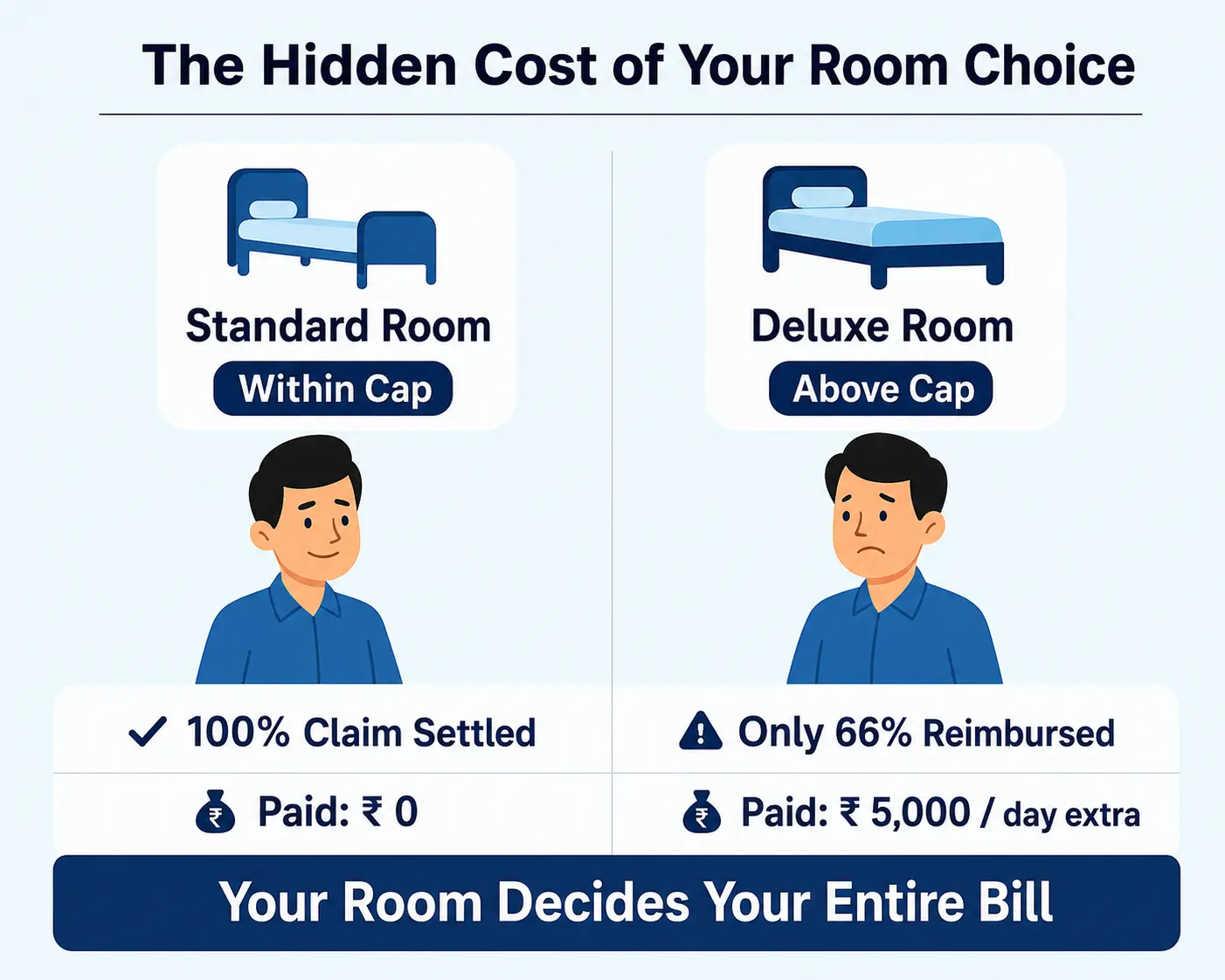
The room rent cap is the single most destructive mechanism in Indian health insurance. Most traditional retail plans and employer-provided group health policies restrict daily room rent coverage to exactly 1% of the total Sum Insured for normal rooms, and 2% for Intensive Care Units (ICU).
Under a standard Rs. 10 Lakh policy, a 1% cap yields an eligible room entitlement of Rs. 10,000 per day. On a Rs. 5 Lakh policy, that entitlement drops to Rs. 5,000 per day. In major metro tertiary hospitals (such as Apollo, Max, Fortis, or Manipal), basic single private rooms frequently cost between Rs. 12,000 and Rs. 18,000 per night, exceeding standard eligibility limits.
Crucial Rule: The financial risk is never limited to paying the room rent difference. It triggers a proportional penalty across your entire medical bill.
Hospitals operate on dual pricing architectures where professional fees, operating theater (OT) rentals, and nursing rates are explicitly linked to the room category occupied. If a patient entitled to a Rs. 10,000 room elects to stay in a Deluxe Room billed at Rs. 15,000, the insurance company does not simply deduct the Rs. 5,000 daily differential. Instead, the insurer applies a proportionate deduction factor across all associated medical fees:
$$\text{Payout Ratio} = \frac{\text{Eligible Room Rent}}{\text{Actual Room Rent}} = \frac{\text{Rs. } 10,000}{\text{Rs. } 15,000} = 66.67%$$
Every subsequent line item associated with hospital care — including surgeon fees, anesthesiologist charges, consultation rounds, and diagnostic procedure fees — is slashed down to 66.67% of the billed value. A Rs. 2,50,000 surgical fee immediately results in an out-of-pocket deficit of over Rs. 83,000 purely due to room categorization.
Proportionate Deduction: Statutory Framework and Exceptions
Following standardisation circulars issued by the Insurance Regulatory and Development Authority of India (IRDAI), insurers are legally restricted from applying proportionate deductions on fixed-cost commodities:
- Exempted Components: Cost of pharmaceuticals, surgical implants (such as coronary stents and orthopedic titanium joints), and medical consumables cannot be reduced proportionally. These must be reimbursed at actual invoice value subject to standard policy caps.
- Vulnerable Components: Surgeon charges, surgical assistant fees, operational theater hire, intensivist visits, nursing monitoring, and daily doctor rounding are all subject to proportional haircuts.
Disease-Specific Sub-Limits: The Hidden Category Ceilings
Even in policies advertising substantial headline limits, insurers routinely embed internal ceilings for common surgical procedures. These clauses restrict reimbursement to predetermined figures regardless of the total sum insured:
| Medical Procedure | Typical Market Hospital Cost (Metro) | Common Sub-Limit (Rs. 5-10L Policy) | Direct Patient Deficit |
|---|---|---|---|
| Cataract Surgery (Per Eye) | Rs. 95,000 – Rs. 1,40,000 | Rs. 35,000 – Rs. 50,000 | Rs. 45,000 – Rs. 90,000 |
| Joint Replacement (Knee/Hip) | Rs. 3,50,000 – Rs. 5,00,000 | Rs. 1,80,000 – Rs. 2,50,000 | Rs. 1,00,000 – Rs. 2,50,000 |
| Hernia Repair | Rs. 1,20,000 – Rs. 1,80,000 | Rs. 60,000 – Rs. 80,000 | Rs. 40,000 – Rs. 1,00,000 |
| Kidney Stone Removal (Lithotripsy) | Rs. 1,10,000 – Rs. 1,60,000 | Rs. 45,000 – Rs. 65,000 | Rs. 45,000 – Rs. 95,000 |
If an employee undergoing bilateral knee replacement holds a corporate policy with a Rs. 2 Lakh joint sub-limit, the remaining balance must be paid directly from household savings, rendering the Rs. 10 Lakh primary cover ineffective for that medical event.
Non-Medical Expenses: The Excluded Consumables List
Medical consumables represent another common source of billing surprises. Under standard insurance terms, items classified under IRDAI's "List I - Expenses Generally Excluded" are deemed non-payable:
- Surgical gloves, PPE kits, surgical masks, sterile drapes, and disposable linen.
- Administration charges, biomedical waste disposal surcharges, and electronic admission documentation fees.
- Syringes, specialized catheter kits, disinfectant solutions, and thermometer probes.
In standard surgical interventions, non-payable consumables routinely comprise 10% to 15% of the gross hospital bill. Without a specific "Consumables Cover Rider," these charges are deducted in full from the final reimbursement statement.
Case Study: An Authentic Surgical Claim Breakdown
The following audit reflects a documented claims file for a major cardiovascular intervention conducted at a private network hospital under a standard Rs. 10 Lakh policy with a 1% room cap:
Advertisement
| Billing Component | Actual Hospital Bill | Allowed Amount by Insurer | Exact Clause / Mathematical Reason Applied |
|---|---|---|---|
| Room Rent (4 Days Deluxe) | Rs. 60,000 (Rs. 15,000/day) | Rs. 40,000 | Capped at 1% of Sum Insured (Rs. 10,000/day maximum limit) |
| Surgeon & OT Charges | Rs. 2,50,000 | Rs. 1,66,666 | Proportionate deduction applied: $(10,000 / 15,000) \times Rs. 2,50,000$ |
| Medicines & Implants | Rs. 1,80,000 | Rs. 1,30,000 | Stent cost covered; non-formulary pharmaceuticals excluded |
| Consumables & Hygiene Packs | Rs. 70,000 | Rs. 0 | Classified under Non-Medical Expenses Schedule (Zero coverage) |
| Diagnostic Lab Profiles | Rs. 40,000 | Rs. 40,000 | Pre-operative blood panels and ECG covered within tariff |
| Gross Total | Rs. 6,00,000 | Rs. 3,76,666 | Net Paid by Insurer (~Rs. 3.8 Lakh) |
Despite maintaining an unexhausted Rs. 10 Lakh cover and incurring a bill well beneath that ceiling, the patient was forced to absorb Rs. 2,23,334 out of pocket. Structural policy conditions reduced the effective financial settlement to just 62.7% of total costs.
The Economics of Upgrading: The "No Room Rent Cap" Rider
Many policyholders retain restrictive legacy policies because they assume that policies without room caps are prohibitively expensive. Actuarial data indicates otherwise:
| Policy Configuration (Age 35, Rs. 10L Cover) | Approximate Annual Premium | Out-of-Pocket Risk During Rs. 6L Surgery |
|---|---|---|
| Standard Policy (1% Room Rent Cap) | Rs. 11,500 – Rs. 14,000 | Rs. 1,50,000 – Rs. 2,50,000+ |
| Modern Policy (No Room Rent Cap / Single Private) | Rs. 13,200 – Rs. 16,800 | Rs. 30,000 – Rs. 60,000 (Consumables only) |
| Comprehensive Policy (+ Consumables Rider) | Rs. 14,500 – Rs. 18,500 | Rs. 0 – Rs. 10,000 (Incidental personal items) |
The premium differential between a policy carrying a 1% room cap and one providing unconstrained "Single Private Room" eligibility is typically Rs. 1,500 to Rs. 3,000 per year. Paying this incremental premium eliminates proportionate deduction risk, potentially saving multiple lakhs during a medical emergency.
The "Cashless Everywhere" Initiative: Operational Reality
In 2024, the General Insurance Council (GIC), in collaboration with all domestic health insurance providers, introduced the "Cashless Everywhere" initiative. This allows policyholders to request cashless admissions at non-network hospitals, provided the facility meets basic clinical accreditation benchmarks.
While this represents structural progress, critical caveats remain:
- Mandatory 48-Hour Pre-Notification: For elective admissions, the insurer must be notified at least 48 hours in advance. For emergency cases, notification must be submitted within 48 hours of admission. Failure to meet these timelines reverts the claim to reimbursement mode.
- Room Rent Clauses Still Apply: Cashless authorization is granted strictly within policy eligibility parameters. If the hospital admits you into a room category above your entitlement, the insurer's initial pre-authorization letter will reduce the approved amount proportionally.
- Billing Tariff Discrepancies: Non-network hospitals are not bound by insurer-negotiated preferred provider network (PPN) rate cards. If the hospital bills tariffs above reasonable and customary limits, the excess charges must be borne entirely by the patient at discharge.
Pre-Hospitalization Checklist: How to Protect Your Claim
Before admitting yourself or a family member for planned medical procedures, follow this operational protocol:
- Demand Single Private Room Verification: Confirm whether your policy mandates a percentage cap (e.g., 1%) or guarantees a specific category ("Single Private A/C Room"). If your policy has a percentage cap, book the room that strictly matches your numerical allowance.
- Inspect Specific Sub-Limit Schedules: Request your insurer's Policy Wordings document (not the marketing brochure) and check the "Specific Illness Limits" table for planned procedures.
- Add a Consumables Rider Immediately: If renewing an existing policy, add a dedicated Consumables Protection Rider. At an incremental cost of Rs. 800 to Rs. 1,500 annually, it protects against the deduction of surgical supplies, PPE, and disposable kits.
- Confirm Network Hospital Status (GIPSA/PPN): Check if the treating hospital belongs to your insurer's Preferred Provider Network. PPN-affiliated hospitals operate under pre-agreed procedure packages, minimizing post-discharge billing disputes.
References
[1] Insurance Regulatory and Development Authority of India (IRDAI). Master Circular on Standardization of Health Insurance Products — IRDAI Guidelines
[2] IRDAI. List of Standardised Non-Payable Items in Health Insurance Claims — IRDAI Regulatory Annexure
[3] General Insurance Council (GIC). Cashless Everywhere Protocol and Hospital Onboarding Guidelines — GIC Framework
Disclaimer: The claim calculations, policy clauses, and regulatory schedules analyzed in this guide are derived from statutory circulars and standard insurance terms. This text is published for educational and consumer awareness purposes and does not constitute formal underwriting advisory or legal insurance counsel.
Advertisement