


The Gold and Silver ETF valuation rule change mandated by the Securities and Exchange Board of India (SEBI) from April 1, 2026 replaces an outdated, multi-step London import-parity price formula with domestic stock exchange polled spot prices. In this guide, you will learn the exact regulatory provisions of SEBI Circular HO/(68)2026-IMD-POD-2/I/5780/2026, see how the shift from London Bullion Market Association (LBMA) fixing prices to Indian exchange spot rates changes daily Net Asset Value (NAV) calculations on a ₹5,00,000 portfolio, and get a step-by-step checklist for buying or selling ETF units without overpaying on the exchanges.
The regulatory amendment under Gazette Notification LAD-NRO/GN/2026/294 alters Regulations 22(9) and 63(9) of the SEBI (Mutual Funds) Regulations, 1996. It directly changes the Seventh Schedule valuation norms that Asset Management Companies (AMCs) must use every evening to price physical gold and silver ingots held in custody.
The Core Problem With the Old Valuation Architecture
Until March 31, 2026, Indian mutual funds valued their bullion holdings through an indirect synthetic conversion route. AMCs took the London AM or PM fixing price published in US Dollars by the London Bullion Market Association (LBMA), converted that dollar figure into Indian Rupees using the reference exchange rate published by Financial Benchmarks India Private Limited (FBIL), and then added theoretical customs duty, Agriculture Infrastructure and Development Cess (AIDC), handling expenses, and port-clearing charges.
Old Valuation Formula:
Landed Import Price = (LBMA USD Fixing Price × FBIL USD/INR Reference Rate) + Customs Duty + AIDC + Port Clearing Charges
While this formula looked robust on paper, it suffered from a fundamental structural flaw: it measured the hypothetical landed cost of imported metal rather than the actual clearing price inside Indian wholesale vaults.
In the physical bullion markets of Zaveri Bazaar in Mumbai, Chandni Chowk in Delhi, and Sowcarpet in Chennai, gold and silver regularly trade at either a substantial premium or a deep discount to synthetic landed import-parity prices. During the festive and wedding quarters (Dhanteras, Diwali, Akshaya Tritiya), physical metal often commands an immediate cash premium of $10 to $25 per troy ounce because physical demand exceeds immediately available vault supplies. Conversely, during periods of high grey-market flows or post-budget customs duty overhangs, domestic metal trades at discounts of $20 to $40 per ounce against theoretical import parity.
Because AMCs were legally prohibited from pricing domestic premiums or discounts into their evening NAV, a chronic dislocation emerged:
- NAV Lag: The fund's published NAV reflected yesterday's London settlement adjusted for theoretical duties, while trading desks were pricing physical delivery based on real-time Indian demand.
- Artificial Tracking Error: AMCs that managed physical buying and selling efficiently appeared to generate high tracking error simply because the benchmark valuation model did not match vault reality.
- iNAV Misleading Retail Traders: During NSE and BSE trading hours, Market Makers (MMs) and Authorized Participants (APs) quoted bid/ask spreads based on Indian spot markets, while retail investors looked at indicative NAVs (iNAVs) calculated off international futures and theoretical customs rates.
What SEBI Circular HO/(68)2026-IMD-POD-2/I/5780/2026 Mandates
To eliminate this structural divergence, SEBI issued Circular HO/(68)2026-IMD-POD-2/I/5780/2026 on February 26, 2026, coming into statutory force on April 1, 2026.
Under the revised norms:
- Domestic Exchange Polled Spot Prices: Every mutual fund must compute daily NAV based on the domestic polled spot prices published daily by nationwide stock exchanges (NSE India and BSE India).
- Transparent Polling Framework: The spot rates are aggregated across accredited physical bullion refiners, vault custodians, and wholesale bullion dealers under a transparent, auditable polling mechanism regulated by SEBI.
- Silver Parity: The valuation rules apply symmetrically to both Gold ETFs and Silver ETFs. AMCs can no longer use international silver fixing prices while domestic silver trades at differing industrial supply premiums.
- Mandatory Disclosures: AMCs must publish both the exchange spot price used for evening NAV and the daily deviation between the exchange closing market price and the scheme's declared NAV on their websites every trading day.
Under the new regime, the fund's physical asset value and per-unit NAV are calculated directly:
New Bullion Portfolio Value = Total Weight of Bullion Held (Grams) × Exchange Polled Domestic Spot Price per Gram
Scheme NAV per Unit = (Bullion Portfolio Value + Cash & Receivables − Accrued Expenses) ÷ Total Outstanding Units

Step-by-Step NAV Comparison: Old vs. New Methodology
To see how this regulatory change shifts fund valuation in practice, let us examine an AMC managing a Gold ETF holding 100 kilograms (1,00,000 grams) of 995.0 purity fine gold bullion. Assume the scheme has 10,00,000 outstanding units, cash receivables of ₹15,00,000, and accrued Total Expense Ratio (TER) and vaulting liabilities of ₹5,00,000.
Suppose on a given trading day:
- LBMA PM Fixing: $2,800 per troy ounce (31.1035 grams).
- FBIL USD/INR Reference Rate: ₹86.50 per USD.
- Customs Duty + AIDC: 6% total effective landed tariff.
- Local Clearing & Port Handling: ₹20 per gram.
- Actual Domestic Polled Spot Price on NSE/BSE: ₹8,350 per gram (reflecting a local wedding-season cash premium).
1. Old Valuation Method (Synthetic Import-Parity)
- Base Landed Cost (USD): $2,800 × (1 + 0.06) = $2,968 per troy ounce
- Landed Cost (INR): $2,968 × ₹86.50 = ₹2,56,732 per troy ounce
- Synthetic Price per Gram: (₹2,56,732 ÷ 31.1035) + ₹20 clearing = ₹8,254.12 + ₹20 = ₹8,274.12 per gram
- Bullion Value (Old): 1,00,000 grams × ₹8,274.12 = ₹82,74,12,000
- Net Assets (Old): ₹82,74,12,000 + ₹15,00,000 − ₹5,00,000 = ₹82,84,12,000
- NAV per Unit (Old): ₹82,84,12,000 ÷ 10,00,000 units = ₹82.84
2. New Valuation Method (Domestic Polled Spot Price)
Under the revised SEBI framework, the AMC directly applies the exchange polled spot price:
- Domestic Polled Spot Rate: ₹8,350.00 per gram (NSE / BSE official polled rate)
- Bullion Value (New): 1,00,000 grams × ₹8,350.00 = ₹83,50,00,000
- Net Assets (New): ₹83,50,00,000 + ₹15,00,000 − ₹5,00,000 = ₹83,60,00,000
- NAV per Unit (New): ₹83,60,00,000 ÷ 10,00,000 units = ₹83.60
Advertisement
Mathematical Impact Summary
| Valuation Metric | Old Synthetic Model | New Domestic Polled Model | Absolute Variance | Percentage Impact |
|---|---|---|---|---|
| Bullion Price per Gram | ₹8,274.12 | ₹8,350.00 | +₹75.88 | +0.917% |
| Total Scheme Asset Value | ₹82.84 Crore | ₹83.60 Crore | +₹76.00 Lakh | +0.917% |
| NAV per Unit | ₹82.84 | ₹83.60 | +₹0.76 | +0.917% |
| Portfolio Value (₹5,00,000 Base) | ₹5,00,000 | ₹5,04,585 | +₹4,585 | +0.917% |
The revised model eliminates an artificial discount of 0.917%. Under the old model, if an investor redeemed units via an Authorized Participant, or if the fund published its evening NAV, the unit holder appeared poorer by ₹4,585 on a ₹5,00,000 holding simply because the AMC was legally bound to ignore domestic cash market reality.
Understanding the Difference Between Market Price, NAV, and iNAV
To trade Gold and Silver ETFs effectively on the secondary market, you must distinguish between three distinct price benchmarks:
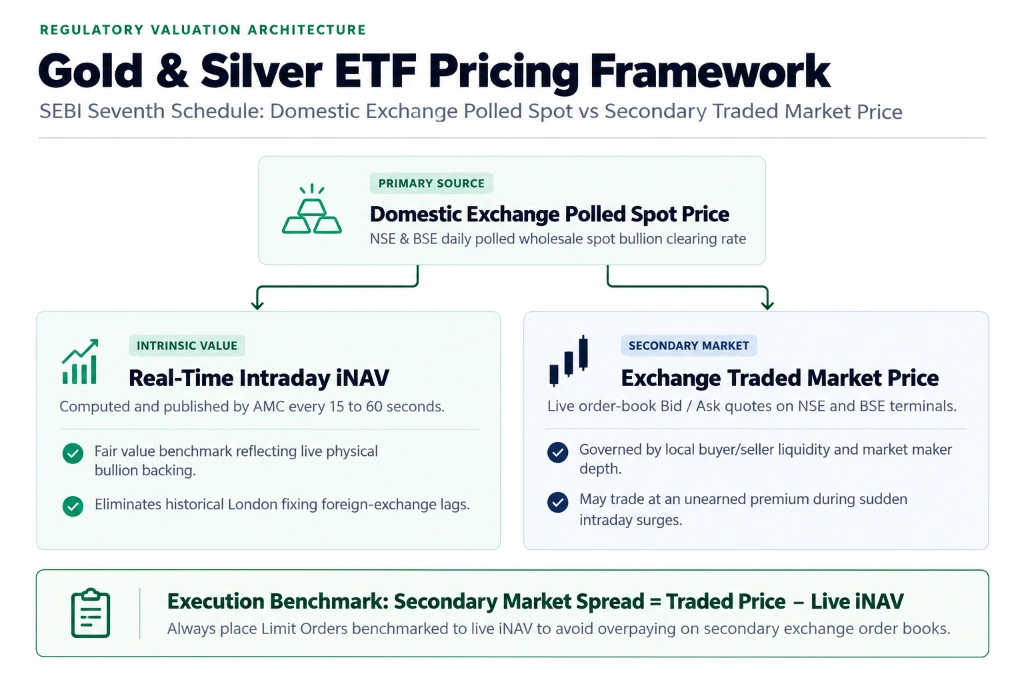
- Exchange Traded Market Price: The price at which units are actively bought and sold on NSE or BSE screens. This is governed entirely by secondary market liquidity, order-book depth, and retail demand.
- Official End-of-Day NAV: The statutory Net Asset Value computed by the AMC after market close (typically published by 9:00 PM IST) using the official closing polled spot price.
- Indicative NAV (iNAV): A real-time estimated NAV published by the AMC throughout the trading day at intervals of 15 seconds to 1 minute. It allows traders to see whether the current market price on the exchange is trading at an unearned premium or discount.
Under the new SEBI guidelines, iNAV calculations must now track real-time domestic futures and exchange polled spot movements instead of synthetic international feeds. This drastically reduces the gap between iNAV and secondary market prices.
Tracking Error vs. Tracking Difference
Investors frequently confuse Tracking Error (TE) with Tracking Difference (TD). Understanding both is critical under the new valuation framework:
Tracking Difference (TD)
Tracking Difference is the cumulative difference between the total return of the ETF and the total return of the underlying benchmark over a specific holding period:
Tracking Difference = Cumulative Total Return of ETF Units − Total Return of Domestic Spot Bullion Benchmark
In a physical bullion fund, Tracking Difference is almost always negative over time due to three recurring drags:
- Total Expense Ratio (TER): Management fees, trustee charges, and audit fees (typically 0.30% to 0.55% annually).
- Physical Vaulting and Insurance: Custody fees paid to vault operators like Brink's or Sequel.
- Cash Drag: A small percentage of fund assets (1% to 3%) held in liquid cash or reverse repos to handle daily creation/redemption operational liquidity.
Tracking Error (TE)
Tracking Error measures the annualized standard deviation of daily return differences between the ETF and its benchmark:
Tracking Error = Annualized Standard Deviation of Daily Return Differences between ETF NAV and Domestic Polled Spot Benchmark
Before April 2026, Gold and Silver ETFs showed artificially inflated Tracking Error because the benchmark (domestic spot price) moved with local market dynamics while the fund NAV moved with the synthetic LBMA model. Under the new SEBI rule, Tracking Error is expected to decline by 30% to 50% across most Indian Gold and Silver ETFs, giving investors a much truer picture of AMC operational efficiency.
5 Practical Execution Rules for ETF Investors on NSE and BSE
Even with a better valuation framework, retail investors can still lose money if they execute orders carelessly on secondary exchange order books. Follow these five rules on every trade:
1. Always Compare Traded Price Against Live iNAV
Never place an order without checking the fund's live iNAV on the NSE or BSE quote screen or AMC website. If the Gold ETF is trading at ₹84.50 while its live iNAV is ₹83.60, you are paying an immediate 1.07% unearned premium. If secondary market liquidity normalizes ten minutes later, that premium can evaporate, leaving you with an instant capital loss.
2. Never Use Market Orders
Secondary market bullion ETF order books can be thin, especially during sudden price spikes. Always place Limit Orders with a specific maximum purchase price. If you use a standard market order, your broker's algorithm will sweep the order book and execute against higher asks placed by predatory arbitrageurs.
3. Avoid the First and Last 15 Minutes of the Trading Session
Between 9:15 AM and 9:30 AM, market makers are still calibrating their physical hedges and pricing models. Spreads are wide, and liquidity is sparse. Similarly, between 3:15 PM and 3:30 PM, market makers square off intraday hedges. Execute your trades between 10:00 AM and 2:45 PM when bid/ask spreads are narrowest.
4. Watch for Budget Customs Duty Changes
When the Government of India adjusts customs duty on gold or silver imports in the Union Budget, physical domestic spot rates react instantaneously. Under the new framework, fund NAV will reflect the actual domestic market price on day one, eliminating the multi-week lag that used to confuse investors under the old synthetic model.
5. Check Creation Unit Thresholds for Large Transactions
If you are investing more than ₹25 Lakh to ₹1 Crore, do not purchase units piecemeal on the exchange. Approach the AMC directly through an Authorized Participant to execute a "Creation Unit" trade. The AMC will create fresh units directly against physical bullion delivery or cash at the exact day's NAV without market order-book slippage.
Disclaimer: This article is for informational and educational purposes only and does not constitute financial, investment, legal, or tax advice. Mutual fund investments are subject to market risks; read all scheme-related documents carefully before investing.
Advertisement