


When a 12-year mid-senior employee is called into an unexpected restructuring meeting—a scene playing out across Indian IT services, fintech, and global capability centres throughout 2026—HR rarely hands over a simple net rupee figure. Instead, you are presented with a multi-line separation proposal mixing contractual notice pay, statutory gratuity, unused privilege leave, and an ex-gratia payout, with a tight 24-to-72-hour window to sign.
As of 21 November 2026, two major statutory shifts govern every rupee that actually lands in your bank account: the Income Tax Act, 2025 (effective 1 April 2026 for Tax Year 2026-27 on the Income Tax e-Filing Portal, which reorganised separation exemptions into Section 19(1) salary deductions alongside Section 18(1)(a) termination compensation), and the Code on Social Security, 2020 and Industrial Relations Code, 2020 (in force via the Ministry of Labour and Employment, enforcing the 50% wage definition for gratuity and revised retrenchment rules). Knowing which buckets are completely tax-free even in the Default New Tax Regime, which buckets trigger immediate 25%–30% TDS, and how Basic-pay clauses quietly shrink your payout is essential before you sign a single page.
1. The Policy & Workplace Context: Four Separate Buckets Inside Your Full & Final Settlement
Indian law does not treat a layoff payout as one lump sum. Your Full and Final (F&F) settlement is legally split into four distinct buckets—two governed by statute and two governed primarily by your employment contract (unless you qualify as a statutory "worker" under the Industrial Relations Code, 2020):
- Notice Pay in Lieu of Notice (Contractual, 100% Taxable): Most mid-senior Indian corporate contracts carry a 60-to-90-day notice clause. If the employer terminates your role immediately and waives the notice period, they owe you notice pay. Crucially, check your appointment letter's exact phrasing: some companies pay notice on Total Fixed Gross Salary, while others restrict notice pay strictly to Basic Pay—cutting that payout in half overnight.
- Statutory Gratuity (Statutory under Code on Social Security, 2020): Because you have crossed five continuous years of service, gratuity is a non-negotiable statutory right payable within 30 days of separation (delays attract simple interest). The formula is Last-Drawn Monthly Wages × (15 ÷ 26) × Completed Years of Service, where any fraction exceeding six months rounds up to the next full year (so 12 years and 7 months counts as 13 years, while 12 years and 4 months counts as 12 years). Under the Labour Codes' 50% wage rule, if excluded allowances exceed 50% of total remuneration, the excess is added back to compute "wages"—significantly lifting gratuity compared to older 35%-Basic salary structures.
- Earned / Privilege Leave Encashment (Policy-Driven, Statutorily Tax-Protected): Employers encash accumulated unused earned/privilege leave (typically capped at 30 to 60 carry-forward days under company HR manuals, usually calculated on Basic Pay). Under Section 19(1), Table Sl. No. 14 of the Income Tax Act, 2025, leave encashed at separation ("retirement, whether on superannuation or otherwise") qualifies for a lifetime deduction cap of ₹25,00,000 for private-sector employees.
- Ex-Gratia Severance / Retrenchment Pay (The "Worker vs. Manager" Divide): Under the Industrial Relations Code, 2020, statutory "workers" (non-managerial, non-supervisory staff) who are retrenched are legally entitled to 15 days' average pay per completed year of service plus an employer contribution equal to 15 days' wages into a state Re-Skilling Fund. However, white-collar managers, leads, and senior professionals generally fall outside the statutory "worker" definition—meaning any extra severance (such as 3 to 6 months' pay) is an ex-gratia contractual payout taxed in full under Section 18(1)(a) ("profits in lieu of salary") rather than enjoying the ₹5 lakh statutory retrenchment deduction.
2. The Financial & Tax Split Table: Every Component Under the Income Tax Act, 2025 (Tax Year 2026-27)
A major structural change arrived on 1 April 2026: under the Income Tax Act, 2025, gratuity, leave encashment, and retrenchment compensation are no longer upfront "exemptions"—they first enter gross salary under Section 16 / Section 18 and are then claimed as deductions under the Section 19(1) Table. Most importantly, every single separation deduction in Section 19(1) remains fully available under the Default New Tax Regime (Section 202).
| F&F Settlement Component | Governing Provision (Income Tax Act, 2025) | Tax-Free Ceiling (Private Sector, Tax Year 2026-27) | Allowed in Default New Regime (Sec 202)? | Key Trap or Statutory Condition |
|---|---|---|---|---|
| Notice Pay (In Lieu of Notice) | Section 16 & Section 18(1)(a) | ₹0 (Nil) — 100% taxable at slab rate | Taxable in both regimes | Check whether your contract computes notice pay on Gross or Basic salary. |
| Statutory Gratuity (12+ Years) | Section 19(1), Table Sl. No. 5 (covered) / Sl. No. 6 (others) | Least of: Actual received, (Wages × 15 ÷ 26 × Years), or ₹20,00,000 lifetime cap | Yes | Private-sector ceiling remains ₹20 lakh (not the ₹25 lakh Central Govt limit). |
| Unused Earned Leave Encashment | Section 19(1), Table Sl. No. 14 | Least of: Actual received, Eligible Days (≤30/yr) × Avg Pay, 10 × Avg Pay, or ₹25,00,000 lifetime cap | Yes | Leave encashed during service is 100% taxable; relief applies only on separation. |
| Corporate Ex-Gratia / Severance (Managers) | Section 18(1)(a) (Profits in lieu of salary) | ₹0 (Nil) — 100% taxable (unless under a qualifying Rule 20 VRS scheme capped at ₹5 lakh under Sl. No. 12) | Taxable in both regimes | Eligible for Section 157 relief (Form No. 39) if service ≥3 yrs and unexpired term ≥3 yrs. |
| Statutory Retrenchment Pay (IRC "Workers") | Section 19(1), Table Sl. No. 10 (Sl. No. 11 if govt-approved) | Least of: Actual received, 15 days' avg pay/year, or ₹5,00,000 | Yes | Restricted to statutory "workers" under labour law; most IT/corporate managers do not qualify. |
| EPF Corpus Balance (12 Years Continuous) | Schedule / Recognised PF Rules (5+ yrs continuous service) | 100% Tax-Free (subject to interest cap on employee contributions above ₹2.5 lakh/yr) | Yes | Separate from employer F&F; claim or transfer via EPFO UAN portal. |
3. Worked Rupee Math: What a ₹24 LPA, 12-Year Employee Actually Banks in Hand
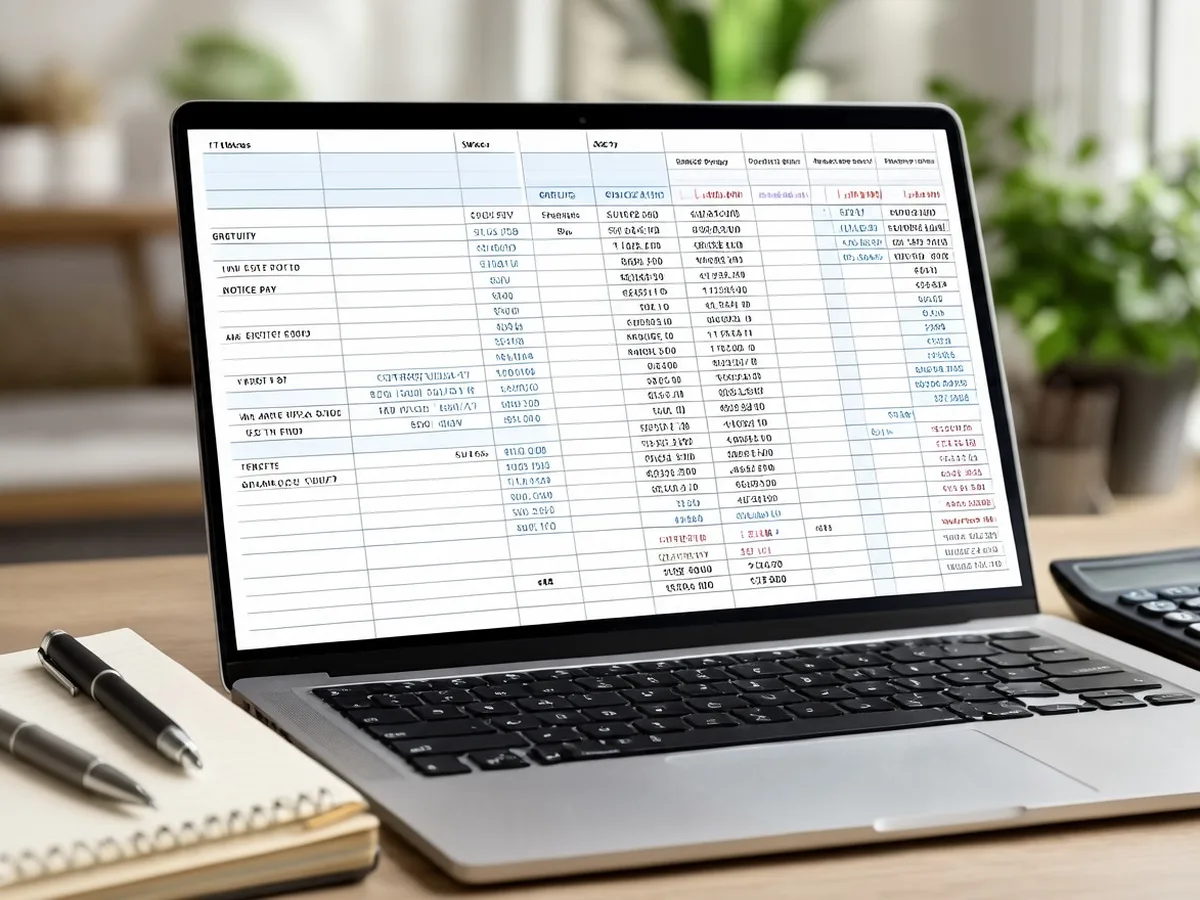
To see how salary structuring and tax slabs collide during a layoff, let us run the exact line-by-line rupee math for a 12-year employee earning ₹24,00,000 annual fixed gross salary (₹2,00,000/month) who is laid off on 30 November 2026 (8 months into Tax Year 2026-27) and remains out of paid employment through 31 March 2027. We compare Structure A (Labour-Code-aligned 50% Basic + Gross Notice Pay) against Structure B (legacy 35% Basic + Basic-only Notice Pay) under the Section 202(1) Default New Tax Regime.
Baseline Parameters & Assumptions:
- Completed Service: 12 years and 4 months (12 completed years for gratuity rounding)
- Regular Salary Already Earned (April–November 2026, 8 Months): 8 × ₹2,00,000 = ₹16,00,000
- Standard Deduction (Section 19(1), Table Sl. No. 2(a) under Section 202): ₹75,000
- Unused Earned Leave Balance: 60 days (paid on monthly Basic Pay basis; 10-month average Basic unchanged)
- Contractual Package Terms: 3 months' Notice Pay in lieu of notice + Statutory Gratuity + 60 Days' Leave Encashment + 6 months' Basic Pay as Ex-Gratia Severance
- Structure A: 50% Wages = ₹1,00,000/month Basic; Notice Pay on Gross ₹2,00,000/month
- Structure B: Legacy 35% Basic = ₹70,000/month; Notice Pay restricted to Basic ₹70,000/month
- Section 202(1) New Regime Slabs (Tax Year 2026-27): Nil up to ₹4L; 5% (₹4L–₹8L); 10% (₹8L–₹12L); 15% (₹12L–₹16L); 20% (₹16L–₹20L); 25% (₹20L–₹24L); 30% above ₹24L; plus 4% Health & Education Cess (zero surcharge below ₹50 lakh).
Plain-Text Calculation Formulas:
- Statutory Gratuity = (Last-Drawn Monthly Wages × 15 × Completed Years) ÷ 26
- Leave Encashment = (Unused Days ÷ 30) × Monthly Basic Salary
- Taxable F&F Component = Notice Pay + Ex-Gratia Severance (Gratuity & Leave deducted under Section 19(1))
- Incremental TDS on F&F = Total Annual Tax (With F&F) - Annual Tax on 8-Month Regular Salary Alone
- Net F&F Cash Banked = Total Gross F&F Package - Incremental TDS on F&F
Line-by-Line Arithmetic:
Baseline Tax on 8 Months' Regular Salary Alone (Before F&F):
- Taxable Regular Salary: ₹16,00,000 - ₹75,000 (Std Ded) = ₹15,25,000 (OneMint calculation).
- Slab Tax under Section 202(1): ₹60,000 (up to ₹12L) + 15% of ₹3,25,000 (₹48,750) = ₹1,08,750; plus 4% Cess (₹4,350) = ₹1,13,100 (already covered by regular monthly TDS) (OneMint calculation).
Structure A — 50% Basic (₹1,00,000) & Gross Notice Pay:
- Notice Pay (3 months × ₹2,00,000 Gross): ₹6,00,000 (100% taxable).
- Statutory Gratuity: (₹1,00,000 × 15 × 12) ÷ 26 = ₹6,92,308 (100% deductible under Section 19(1) Sl. No. 5; below ₹20L cap) (OneMint calculation).
- Leave Encashment (60 days): (60 ÷ 30) × ₹1,00,000 = ₹2,00,000 (100% deductible under Section 19(1) Sl. No. 14; below ₹25L cap) (OneMint calculation).
- Ex-Gratia Severance (6 months × ₹1,00,000 Basic): ₹6,00,000 (100% taxable under Section 18(1)(a)).
- Total Gross F&F Package (Structure A): ₹6,00,000 + ₹6,92,308 + ₹2,00,000 + ₹6,00,000 = ₹20,92,308 (OneMint calculation).
- Taxable F&F Slice: ₹6,00,000 + ₹6,00,000 = ₹12,00,000, pushing total taxable income from ₹15,25,000 to ₹27,25,000 (OneMint calculation).
- Incremental Slab Tax on ₹12,00,000 (₹15.25L to ₹27.25L):
- ₹15.25L–₹16.00L (₹75,000 × 15%) = ₹11,250
- ₹16.00L–₹20.00L (₹4,00,000 × 20%) = ₹80,000
- ₹20.00L–₹24.00L (₹4,00,000 × 25%) = ₹1,00,000
- ₹24.00L–₹27.25L (₹3,25,000 × 30%) = ₹97,500
- Base Incremental Tax = ₹2,88,750; plus 4% Cess (₹11,550) = ₹3,00,300 (effective tax rate 14.35% across the whole F&F package) (OneMint calculation).
- Net F&F Cash Banked (Structure A): ₹20,92,308 - ₹3,00,300 = ₹17,92,008 (OneMint calculation).
Advertisement
Structure B — Legacy 35% Basic (₹70,000) & Basic-Only Notice Pay (Same ₹24 LPA CTC):
- Notice Pay (3 months × ₹70,000 Basic): ₹2,10,000 (100% taxable).
- Statutory Gratuity: (₹70,000 × 15 × 12) ÷ 26 = ₹4,84,615 (tax-free) (OneMint calculation).
- Leave Encashment (60 days): (60 ÷ 30) × ₹70,000 = ₹1,40,000 (tax-free) (OneMint calculation).
- Ex-Gratia Severance (6 months × ₹70,000 Basic): ₹4,20,000 (100% taxable) (OneMint calculation).
- Total Gross F&F Package (Structure B): ₹2,10,000 + ₹4,84,615 + ₹1,40,000 + ₹4,20,000 = ₹12,54,615 (OneMint calculation).
- Taxable F&F Slice: ₹2,10,000 + ₹4,20,000 = ₹6,30,000, pushing taxable income from ₹15,25,000 to ₹21,55,000 (OneMint calculation).
- Incremental Slab Tax on ₹6,30,000 (₹15.25L to ₹21.55L): ₹11,250 (15%) + ₹80,000 (20%) + ₹38,750 (25% on ₹1.55L) = ₹1,30,000; plus 4% Cess (₹5,200) = ₹1,35,200 (OneMint calculation).
- Net F&F Cash Banked (Structure B): ₹12,54,615 - ₹1,35,200 = ₹11,19,415 (OneMint calculation).
The Fiscal-Year Timing Penalty (November Exit vs. March 2027 Exit on Structure A):
If Structure A’s layoff happened on 31 March 2027 (after 12 full months of ₹24L salary, taxable base ₹23,25,000), the same ₹12,00,000 taxable F&F slice sits almost entirely in the 30% bracket (₹75,000 @ 25% + ₹11,25,000 @ 30% = ₹3,56,250 base + ₹14,250 cess = ₹3,70,500 tax)—costing ₹70,200 more in tax solely due to timing before Section 157 / Form No. 39 relief (OneMint calculation).
Variance Callout: On the exact same ₹24 lakh annual salary and 12-year tenure, an employee exiting under a 50%-Basic / Gross-Notice structure banks ₹17,92,008 net in hand (paying ₹3,00,300 in tax, or 14.35% overall), whereas a peer trapped under a 35%-Basic / Basic-only Notice clause banks just ₹11,19,415—a ₹6,72,593 net cash shortfall that disappears before you even start job hunting (OneMint calculation).
(Note: Constants used are a 26-day statutory gratuity divisor, 30-day leave divisor, Section 202(1) slabs for Tax Year 2026-27 (Income Tax Act, 2025), and 4% Health and Education Cess. If an employee receives a larger payout that pushes total taxable income above ₹50,00,000, a 10% surcharge applies (subject to marginal relief)).
4. Epistemic Honesty: The "Forced Resignation" Trap, EPF/EPS Rules, and What We Don't Know Yet
Three operational friction points regularly cost departing 12-year employees lakhs of rupees in ways that standard calculators miss:
- "Resign Voluntarily" vs. Involuntary Separation Letter: Many Indian employers pressure laid-off staff to submit a voluntary resignation email in exchange for a clean relieving letter. While a clean relieving letter protects future background checks, resigning voluntarily forfeits your right to claim Section 157 relief (Form No. 39) on termination compensation (Rule 73(1), Sl. No. 4 requires compensation on termination of employment where service is ≥3 years and unexpired term is ≥3 years) and eliminates any statutory retrenchment claim if you are a non-managerial worker. Never resign until the ex-gratia payout and notice-waiver terms are documented in writing.
- Your 12-Year EPF & EPS Corpus Is Separate—Don't Touch EPS Prematurely: After 12 years of continuous service, your EPF corpus is 100% tax-free to withdraw or retain (remembering the ₹25,000 statutory wage ceiling active since 17 September 2026 under Notification S.O. 5109(E)—see OneMint's Check Your October Payslip: The EPF Wage Ceiling Is Now ₹25,000). Crucially, because you have more than 10 years of pensionable service, you are ineligible to withdraw your EPS pension lump sum under EPS 2026—you have locked in a lifelong monthly pension starting at age 58 (or reduced early pension from age 50). Review OneMint's EPS 2026 Replaces EPS 1995: What Job-Switchers Keep, Lose and Must Decide About the 36-Month Pension Wait before submitting any EPFO claim.
- The 6-Month Gratuity Rounding Cliff: If you are laid off at 12 years and 5 months, you receive gratuity for 12 years (₹6,92,308 on ₹1L wages). If your official last working day is negotiated forward by just 6 weeks (or if you serve your 90-day notice period instead of taking immediate pay in lieu) to cross 12 years and 6 months + 1 day, statutory rounding lifts your service to 13 completed years—adding ₹57,692 tax-free overnight (OneMint calculation).
What We Don't Know Yet
- State-Level Enforcement Variance of the Industrial Relations Code Re-Skilling Fund: While the central Labour Codes are in force and states including Gujarat, Karnataka, Tamil Nadu, Uttar Pradesh, Telangana, Haryana, Punjab, and Delhi have notified state rules, major corporate hubs such as Maharashtra, West Bengal, and Kerala were still completing final state rule stages as of October 2026—creating regional variation in how retrenchment re-skilling contributions operate for non-managerial staff.
- CPC Automated Processing of Form No. 39 (Section 157 Relief) in Tax Year 2026-27: Because Tax Year 2026-27 is the inaugural filing cycle under the Income Tax Act, 2025 and Income-tax Rules, 2026, automated verification workflows for Form No. 39 (replacing old Form 10E) under Rule 73(3) will undergo their first live assessment cycle in mid-2027.
5. What This Does NOT Mean
- It does NOT mean switching to the Old Tax Regime saves tax on Gratuity or Leave Encashment: Under the Income Tax Act, 2025, Section 19(1) deductions for Gratuity (Sl. No. 5) and Leave Encashment (Sl. No. 14) apply identically in the Default New Tax Regime (Section 202). Switching to the Old Regime helps only if your non-severance Chapter VIII deductions (such as Section 123 investments and Section 22 home-loan interest) outweigh the New Regime's much lower slab rates.
- It does NOT mean your employer can legally withhold gratuity because of a restructuring: Under the Payment of Gratuity provisions subsumed into the Code on Social Security, 2020, gratuity can be forfeited only for documented wilful damage, riotous behaviour, or offences involving moral turpitude—never for business layoffs or performance restructuring.
- It does NOT mean your employer will automatically apply Section 157 relief in payroll TDS: Employers almost always deduct full slab TDS on ex-gratia payouts during F&F settlement; you must typically file Form No. 39 yourself on the Income Tax portal and claim the excess TDS back as a refund when filing your Tax Year 2026-27 return.
6. Actionable Step-by-Step Employee Audit: Five Checks Before Signing Your Separation Agreement
Before signing your Full & Final release document, run through this five-point verification checklist:
- Audit the "Wages" Base on Your Gratuity Sheet: Divide your Basic Pay + DA by your total monthly fixed salary. If Basic + DA is below 50% of total remuneration, ask HR in writing how they applied the Code on Social Security, 2020 50% wage definition to your gratuity calculation. Also check if serving notice (instead of immediate exit) pushes your tenure past the 6-month rounding threshold for an extra year of tax-free gratuity.
- Verify Your Lifetime Caps on Gratuity (₹20L) and Leave Encashment (₹25L): Under Section 19(2) of the Income Tax Act, 2025, both the ₹20 lakh gratuity cap and ₹25 lakh leave encashment cap are cumulative lifetime limits across all employers. Subtract any tax-free gratuity or leave encashment you claimed at a previous employer before assuming 100% of this payout is tax-free.
- Check Your Notice-Pay Clause & Negotiate "Garden Leave" Timing: If you are being laid off in February or March, ask HR whether your separation can be structured as paid garden leave crossing 1 April (splitting notice/severance across two Tax Years) or confirm that the separation letter explicitly labels the ex-gratia payout as "Compensation on Termination of Employment" so you preserve eligibility for Section 157 relief via Form No. 39.
- Lock In Family Health Insurance Continuity Before Your Last Working Day: Corporate group health cover terminates at midnight on your official last working day. At least 15–30 days prior to exit, either port your group policy to an individual retail policy with the same insurer (preserving waiting-period credits) or verify that your independent personal health cover is active.
- Re-Model Your Tax & Cash Runway Immediately: Plug your year-to-date salary plus taxable F&F slice into OneMint’s Income Tax Calculator, check your remaining year-end compliance deadlines in The 60-Day Money Checklist: Dhanteras (6 Nov) to 31 December 2026, map your old-to-new tax sections via Income Tax Act 2025 Section Translator, and park your net F&F runway safely.
Primary Sources & References (Verified as of 21 November 2026)
- Central Board of Direct Taxes (CBDT), Ministry of Finance: The Income Tax Act, 2025 (effective 1 April 2026 for Tax Year 2026-27) — Section 16 (Salary definition), Section 18(1)(a) (Profits in lieu of salary / termination compensation), Section 19(1) Table Sl. Nos. 2(a), 5, 6, 10, 11, 12, and 14 (Standard deduction, Gratuity, Retrenchment, VRS, and Leave Encashment deductions), Section 157 & Rule 73 / Form No. 39 (Relief on termination compensation), Section 202(1) (Default New Tax Regime slabs), and Section 536(2)(j) (continuation of ₹20 lakh gratuity, ₹25 lakh leave encashment, and ₹5 lakh retrenchment ceilings).
- Ministry of Labour and Employment, Government of India: Code on Social Security, 2020 (50% wage definition and statutory gratuity formula Wages × 15 ÷ 26 × Years, 30-day payout timeline) and Industrial Relations Code, 2020 (Act No. 35 of 2020) (retrenchment definition, 15 days' average pay, and Re-Skilling Fund provisions).
- Employees' Provident Fund Organisation (EPFO): Notification S.O. 5109(E) (17 September 2026) on the ₹25,000 wage ceiling and Employees' Pension Scheme (EPS), 2026 (epfindia.gov.in).
Advertisement