


The NPS 0.20% annual fee introduced by the Pension Fund Regulatory and Development Authority (PFRDA) from October 1, 2026 fundamentally restructures how Point of Presence (PoP) distributors and banks are compensated across the National Pension System.
Instead of earning modest per-contribution transaction fees, PoP intermediaries now receive an annual Assets Under Management (AUM) trail commission of up to 0.20% deducted directly from subscriber retirement units. Even more critically, under Paragraph 5 of the regulatory circular, your liability for this charge depends entirely on your original onboarding registration channel—not how you transfer money today.
In this guide, you will learn the exact provisions of PFRDA Circular PFRDA/2026/46/REG-POP/08, understand why subsequent direct contributions via eNPS or D-Remit fail to bypass PoP trail charges if your Permanent Retirement Account Number (PRAN) remains mapped to a bank or broker, examine the compounding math on a ₹20,00,000 retirement corpus, and follow a step-by-step audit to check and de-link your PRAN across the three Central Recordkeeping Agencies (Protean CRA, KFintech CRA, and CAMS CRA).
Why Did PFRDA Restructure PoP Intermediary Charges?
A Point of Presence (PoP) is any authorized entity that registers subscribers, processes Know-Your-Customer (KYC) documentation, and services National Pension System accounts. PoPs include major commercial banks (SBI, HDFC Bank, ICICI Bank, Axis Bank), brokerage firms (Zerodha, ICICI Direct, Kotak Securities), and fintech platforms.
Historically, PoPs were compensated primarily through a transaction-based model:
- Registration Fee: ₹200 one-time fee on account opening.
- Contribution Charge: 0.25% to 0.30% of each contribution amount (subject to a minimum of ₹30 and a maximum cap of ₹25,000).
While this model rewarded distributors when subscribers deposited fresh money, it created two major industry distortions:
- Low Distributor Retention: Banks and brokers had little financial incentive to provide ongoing portfolio advisory or service existing accounts once initial deposits slowed down.
- Subscribers Bypassing Distributors via D-Remit: Savvy investors set up Direct Remittance (D-Remit) virtual accounts to bypass the 0.30% contribution fee, depriving distributors of expected revenue.
To make NPS distribution viable for private wealth managers and bank branch networks, PFRDA issued Circular PFRDA/2026/46/REG-POP/08 on August 28, 2026, transitioning PoP compensation from a per-transaction model to an ongoing asset-based trail model starting October 1, 2026.
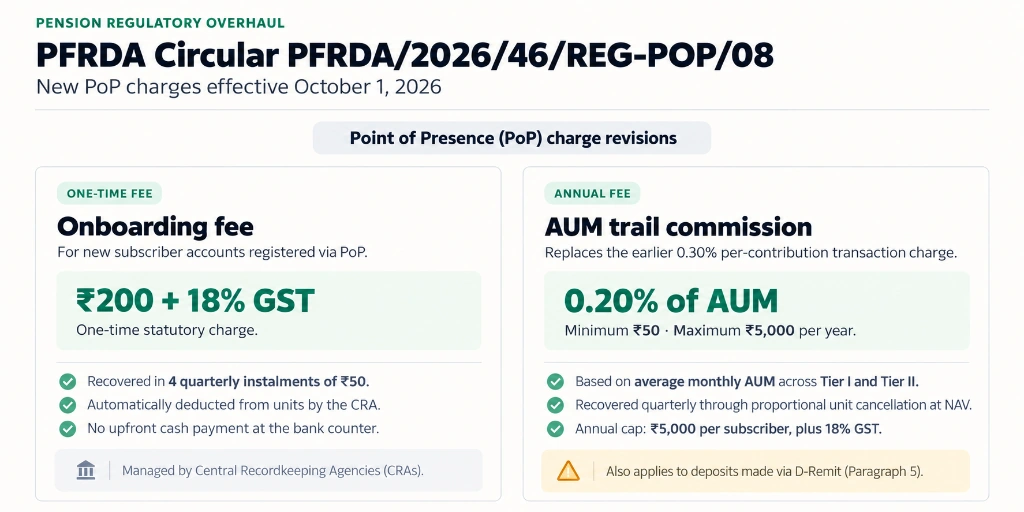
The New Fee Schedule: Key Numbers to Know
Under the revised PFRDA schedule, the charges applicable to PoP-linked accounts are:
- Revised Onboarding Fee: A flat fee of ₹200 plus applicable GST. Rather than requiring cash payment at registration, the CRA recovers this fee automatically in four equal quarterly installments of ₹50 each by redeeming units from the subscriber's PRAN.
- Annual AUM Trail Commission: 0.20% per annum (20 basis points) on the subscriber's average monthly Assets Under Management (AUM), calculated across Tier-I and Tier-II accounts:
- Minimum Annual Floor: ₹50 per annum.
- Maximum Annual Cap: ₹5,000 per annum (plus 18% GST).
- Recovery Mechanism: The trail fee is calculated monthly, compounded, and deducted on a quarterly basis through unit cancellation by the CRA at the prevailing scheme NAV.

The Paragraph 5 Onboarding Trap Explained
The most controversial element of PFRDA Circular PFRDA/2026/46/REG-POP/08 is found in Paragraph 5:
"The applicability of PoP charges shall be determined strictly by the registration status and mapped PoP code associated with the Permanent Retirement Account Number (PRAN). Contributions made through digital channels, including D-Remit and e-NPS payment gateways, shall continue to attract trail commission payable to the mapped PoP entity unless an official transfer of PoP to Direct e-NPS is registered on the Central Recordkeeping Agency system."
What Does This Mean in Plain English?
If you opened your NPS account five years ago at a bank branch (e.g., while applying for a home loan at HDFC Bank or SBI) or through a stockbroker app, your PRAN was registered with that entity's unique PoP Registration Number (PoP-SP Code).
Even if you have not visited that bank branch in five years, and even if you transfer your monthly ₹50,000 contribution directly through Net Banking or D-Remit virtual accounts without using the bank's portal, your account remains mapped to that PoP.
Starting October 1, 2026, the CRA will automatically deduct 0.20% of your total retirement corpus every year and wire it directly to that bank as a servicing commission!
Mathematical Impact on a ₹20,00,000 Corpus Over 15 Years
To see how an apparently small fee of 0.20% impacts long-term retirement wealth, let us compare two investors:
- Investor A (PoP-Mapped): Account originally opened through a bank PoP. Pays 0.20% AUM trail fee annually (subject to the ₹5,000 cap).
- Investor B (Direct e-NPS): Account registered directly on e-NPS with no PoP intermediary. Pays ₹0 in PoP trail fees.
Scenario Parameters:
- Starting Corpus: ₹20,00,000 (Accumulated over previous years)
- Annual Contribution: ₹1,50,000 (added at start of each year)
- Expected Investment Return: 10.00% annualized across Scheme E (Equity), C (Corporate Bonds), and G (Govt Securities).
- Investment Horizon: 15 Years
- Fee Model: PoP Trail Fee = 0.20% of AUM capped at ₹5,000/year + 18% GST (Total ₹5,900/year max).
Statutory Fee Formula:
Annual PoP Trail Fee = 0.20% × Average Monthly AUM (Minimum ₹50, Maximum ₹5,000 per year)
Total Annual Deduction (incl. 18% GST) = Annual PoP Trail Fee × 1.18
Advertisement
On an initial corpus of ₹20,00,000:
- Base Annual Fee: ₹20,00,000 × 0.20% = ₹4,000
- With 18% GST: ₹4,000 × 1.18 = ₹4,720 per year
- Quarterly Unit Cancellation: ₹4,720 ÷ 4 = ₹1,180 per quarter
As the corpus crosses ₹25,00,000 by Year 2:
- Base Annual Fee: ₹25,00,000 × 0.20% = ₹5,000 (Maximum Statutory Cap Reached)
- Annual Cap with 18% GST: ₹5,000 × 1.18 = ₹5,900 per year
- Quarterly Units Cancelled: ₹1,475 ÷ Prevailing Scheme NAV
Compounding Wealth Impact Over 15 Years
| Milestone | Investor B (Direct e-NPS) | Investor A (PoP-Mapped) | Cumulative Wealth Difference |
|---|---|---|---|
| Year 1 | ₹23,65,000 | ₹23,60,280 | -₹4,720 |
| Year 3 | ₹32,69,815 | ₹32,52,530 | -₹17,285 |
| Year 5 | ₹43,72,527 | ₹43,44,792 | -₹27,735 |
| Year 10 | ₹85,50,429 | ₹84,85,618 | -₹64,811 |
| Year 15 | ₹1,52,86,543 | ₹1,51,69,720 | -₹1,16,823 |
Over a 15-year horizon, Investor A surrenders ₹1,16,823 in total wealth to an intermediary who performed zero ongoing advisory or administrative work. For high-net-worth subscribers with family accounts, this unnecessary drag multiplies.
Who is Exempt from the 0.20% Annual Fee?
Not every NPS subscriber pays the 0.20% AUM trail fee. The following categories are legally exempt:
- Direct e-NPS Subscribers: Anyone who opened their NPS account directly on the official eNPS web portal (enps.nsdl.com or the corresponding portals of KFintech or CAMS) without selecting a bank or corporate distributor. In these accounts, the PoP field is marked as
DIRECTorCRA-DIRECT. - Government Sector Subscribers: Mandatory Central Government, State Government, and Autonomous Body employees whose PRANs are administered through institutional nodal offices (Pay and Accounts Offices / Treasury Offices).
- Corporate NPS (Under Direct Model): Corporate employees whose employers have adopted the Direct-CRA model rather than a commercial PoP-Corporate tie-up.
How to Audit Your PRAN: 3-Step Verification
To verify whether your NPS account is mapped to a commercial PoP, follow this 3-step audit across your CRA portal:
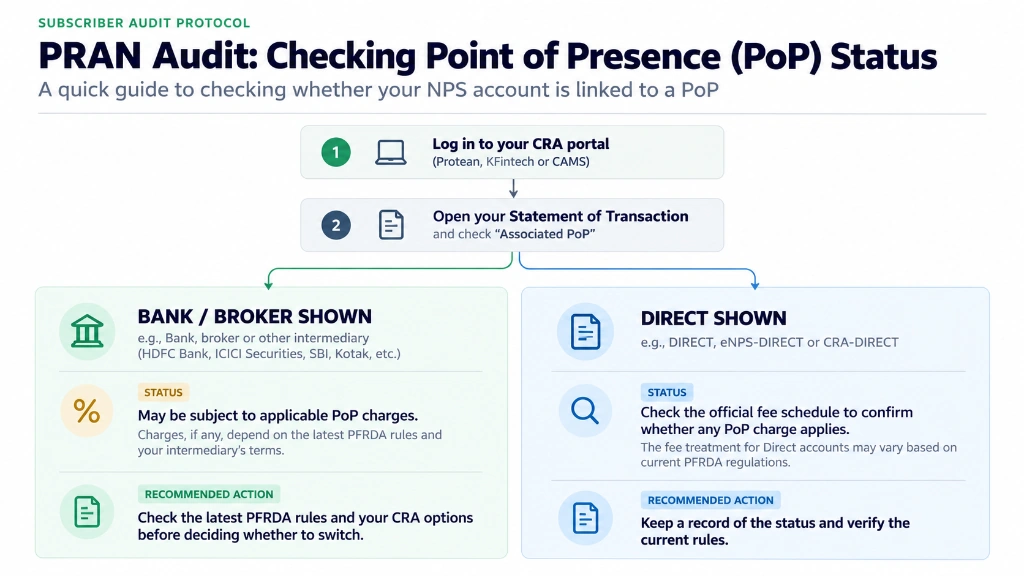
Step 1: Log In to Your Central Recordkeeping Agency Portal
Visit the web portal or mobile app of your designated CRA:
- Protean CRA (formerly NSDL): cra-nsdl.com
- KFintech CRA: nps.kfintech.com
- CAMS CRA: camsnps.com
Step 2: Download Your Latest Statement of Transaction (SOT)
Navigate to Transaction Statement -> Statement of Holding / SOT for the current financial year.
Step 3: Inspect the "PoP Details" Section
Look at the top header of the PDF document:
- If PoP Name displays a commercial entity like HDFC Bank Limited, ICICI Securities, or State Bank of India, your account is mapped to a private intermediary and will be charged the 0.20% annual fee.
- If PoP Name displays eNPS, Direct, or CRA Direct, you are completely exempt.
How to Shift Your PRAN from a PoP to Direct e-NPS
If your account is currently mapped to an intermediary that provides no service, you can legally transfer your PRAN to Direct e-NPS through the following procedure:
- Access the CRA Shifting Portal: Log in to your subscriber portal on Protean, KFintech, or CAMS.
- Navigate to Intermediary Shifting: Click on
Demographic Changes->Change of Point of Presence (PoP) / PoP-SP. - Select Direct e-NPS Option: Under target entity, select
Direct e-NPSorCRA-Directas the new servicing channel. - Authenticate via Aadhaar OTP or DigiLocker: Complete the digital KYC re-verification to authorize the change of mapped distributor.
- Verify the Confirmation Receipt: Once processed (typically within 3 to 7 business days), download the updated Subscriber Master List (SML) to confirm that the PoP status has changed to
Direct.
By completing this simple 10-minute administrative change, you permanently protect your retirement corpus from recurring trail commission deductions throughout your working life.
Disclaimer: This article is for informational and educational purposes only and does not constitute financial, investment, or retirement planning advice. Regulatory circulars, fee caps, and operational guidelines are subject to modification by PFRDA and relevant statutory authorities.
Advertisement