

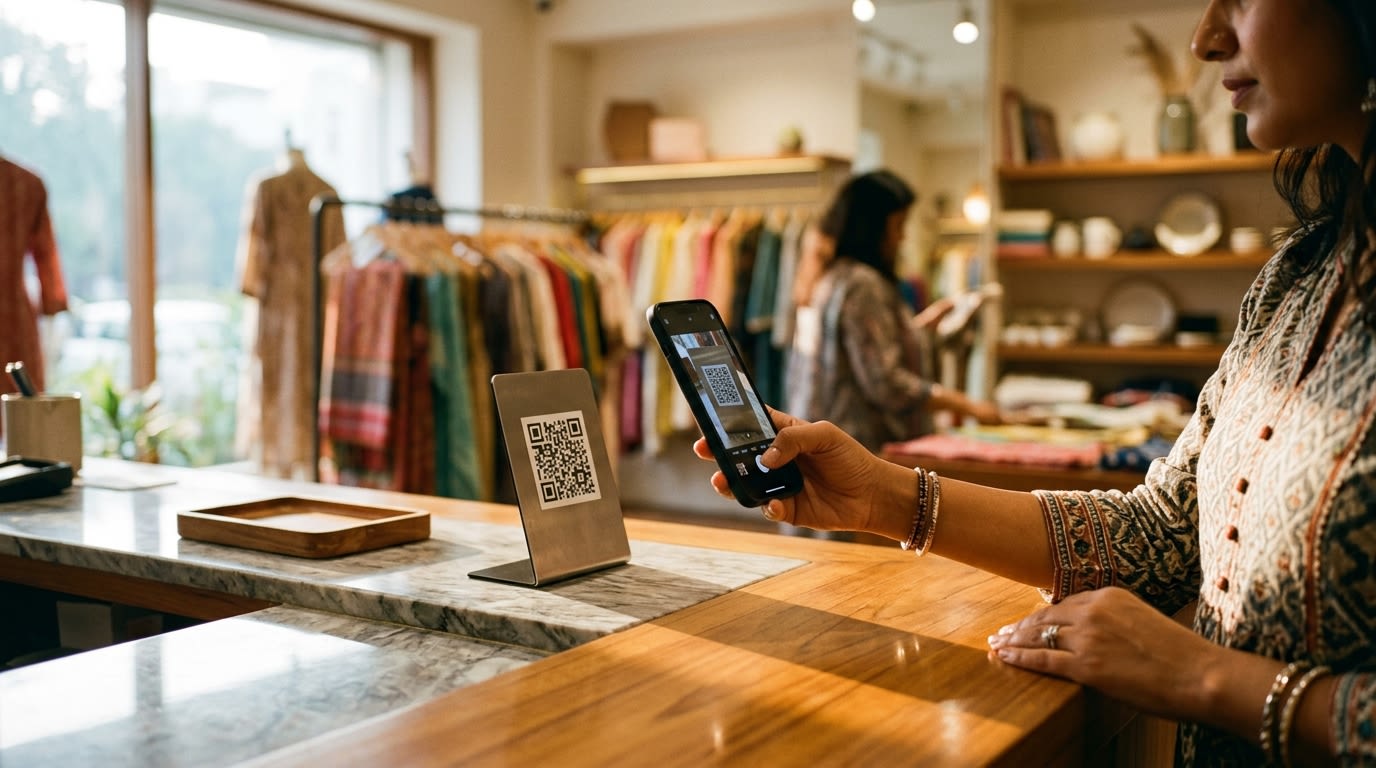
Making UPI payments above ₹2,000 at a neighbourhood electronics store, jewellery showroom, or hospital billing counter sometimes triggers an unexpected demand from the cashier: "Sir, UPI above ₹2,000 attracts merchant charges, so you will have to pay an extra 1.5% or 2%."
This demand is almost always unjustified and directly violates Indian payment regulations. In this guide, you will learn the legal and regulatory rules governing Unified Payments Interface (UPI) surcharges in India, break down the exact difference between bank-account transfers, prepaid wallets, and credit cards on UPI, see the statutory mandate of Section 10A of the Payment and Settlement Systems Act, 2007, and get an actionable 5-step checklist to handle checkout demands at the billing counter.
The Origin of the ₹2,000 Myth
Why does almost every shopkeeper who demands an extra fee quote the exact threshold of ₹2,000?
The confusion traces back to April 2023, when the National Payments Corporation of India (NPCI) issued an operational circular introducing an interchange fee of up to 1.1% on merchant transactions above ₹2,000 conducted through Prepaid Payment Instruments (PPIs).
PPIs refer exclusively to digital wallets and gift cards—such as Paytm Wallet, PhonePe Wallet, Amazon Pay Wallet, or Mobikwik Wallet. When a customer pays a merchant by scanning an interoperable UPI QR code using funds loaded inside a digital wallet, the wallet issuer (e.g., Paytm Payments Bank or PhonePe Wallet) is compensated via an interchange fee paid by the merchant's acquiring bank.
However, misinformed merchants and opportunistic retailers conflated this specific PPI wallet rule with all UPI transactions:
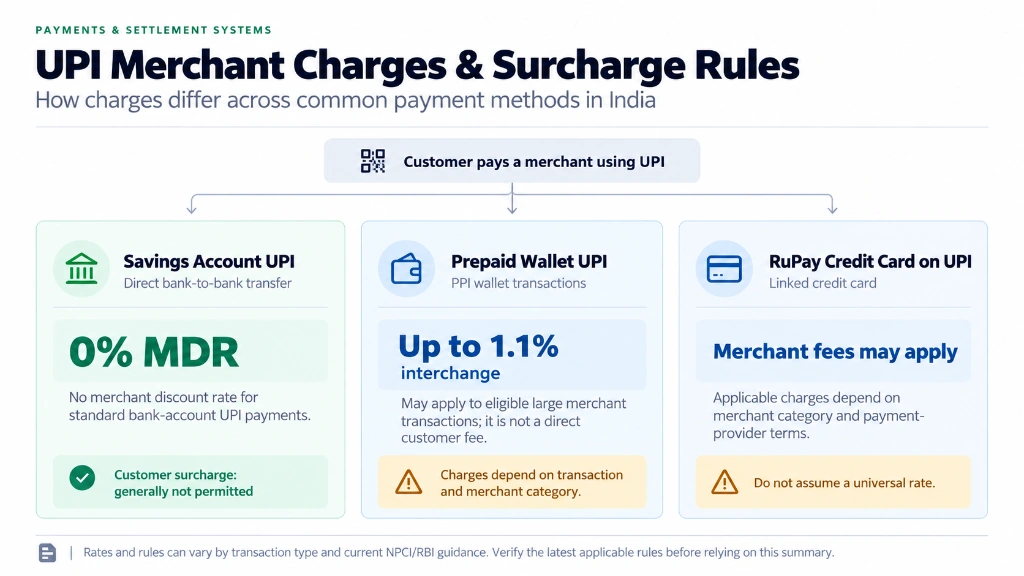
As shown in the architecture above, normal bank-to-bank UPI transfers have zero merchant discount rate (MDR), regardless of whether the transaction is for ₹50, ₹2,00, or ₹1,00,000.
The Statutory Mandate: Section 10A of PSSA, 2007
The legal foundation prohibiting charges on bank UPI transactions is statutory federal law. Under the Finance (No. 2) Act, 2019, the Parliament of India inserted Section 10A into the Payment and Settlement Systems Act, 2007, effective January 1, 2020:
"Notwithstanding anything contained in this Act, or any other law for the time being in force, no bank or system provider shall impose any charge on a payer or payee for using prescribed electronic modes."
The prescribed electronic modes notified by the Central Government include:
- Debit Card powered by RuPay.
- Unified Payments Interface (UPI).
- Unified Payments Interface Quick Response Code (UPI QR Code).
Following this statutory change, the Central Board of Direct Taxes (CBDT) issued Circular No. 32/2020 clarifying that any merchant or bank demanding a surcharge or convenience fee on payments made through prescribed electronic modes violates Section 10A. Under Section 271DB of the Income-tax Act, 1961, entities failing to provide or penalising the use of prescribed electronic payment modes face a statutory penalty of ₹5,000 per day of continuing default.
Comparing the Three UPI Payment Instruments
To understand what happens behind the scenes when you scan a QR code, consider how money flows across the three distinct instruments:
1. Bank Account-to-Bank Account UPI (Person-to-Merchant / P2M)
- Funding Source: Your savings or current bank account linked via your mobile number (State Bank of India, HDFC Bank, ICICI Bank, etc.).
- Merchant Discount Rate (MDR): 0.00%. Neither the issuing bank nor the acquiring app (Google Pay, PhonePe, Paytm, BharatPe) charges the shopkeeper a single rupee.
- Consumer Surcharge: Strictly Illegal. Demanding an extra 1% to 2% is a direct regulatory violation.
2. PPI Wallet-to-Merchant UPI (Interoperable Wallet)
- Funding Source: Pre-loaded balance in a prepaid wallet (e.g., Paytm Wallet balance).
- Interchange Fee: Under NPCI guidelines, transactions above ₹2,000 incur an interchange fee between 0.5% and 1.1% depending on the merchant category code (MCC). For example, fuel stations pay 0.5%, groceries pay 0.9%, and retail stores pay 1.1%.
- Who Pays It? The fee is settled internally between payment aggregators and the wallet issuer. It is a merchant operating cost, similar to merchant rent or electricity.
- Consumer Surcharge: Illegal. NPCI circulars explicitly state that merchants cannot pass interchange costs onto consumers as a checkout surcharge.
3. RuPay Credit Card Linked to UPI
- Funding Source: A virtual or physical RuPay credit card linked to your UPI app.
- Merchant Discount Rate (MDR): For transactions above ₹2,000, acquiring banks deduct standard credit card MDR (typically ~2% plus GST). Transactions under ₹2,000 are exempt for small merchants with turnover below ₹20 Lakh.
- Consumer Surcharge: Contractual Violation. Under Reserve Bank of India (RBI) merchant acquiring guidelines and standard card acceptance agreements, merchants are legally barred from levying a "swipe fee" or "convenience surcharge" on card payments unless expressly authorized by government notification (such as specific utility or fuel surcharges permitted under specific rules).
The Mathematical Breakdown: Legal vs. Surcharged Checkout
Let us calculate the financial impact when a retailer adds an illegal 2% surcharge on a purchase of ₹15,000 (such as a smartphone or television component):
1. Statutory Clean Billing
The total cost to the consumer must strictly equal the retail price plus applicable GST:
- Base Item Price + Applicable GST: ₹15,000
- Payment Method: Savings Bank Account via UPI
- Merchant Discount Rate (MDR): 0%
- Customer Surcharge: ₹0
- Final Amount Debited: ₹15,000
Advertisement
2. Illegal Merchant Surcharge Billing
If the cashier demands an illegal 2% surcharge:
- Base Invoice Amount: ₹15,000
- Illegal Surcharge (2%): ₹15,000 × 0.02 = ₹300
- Total Amount Demanded: ₹15,000 + ₹300 = ₹15,300
- Direct Financial Loss to Consumer: ₹300
Surcharge Impact Matrix
| Transaction Amount | Payment Instrument | Legal Cost to Buyer | Illegal 2% Surcharge | Net Consumer Loss |
|---|---|---|---|---|
| ₹2,500 (Grocery Bill) | Bank UPI | ₹2,500 | ₹50 | -₹50 |
| ₹10,000 (Clothing / Apparel) | Bank UPI | ₹10,000 | ₹200 | -₹200 |
| ₹25,000 (Electronics / Laptop) | Bank UPI | ₹25,000 | ₹500 | -₹500 |
| ₹1,00,000 (Jewellery / Bullion) | Bank UPI | ₹1,00,000 | ₹2,000 | -₹2,000 |
On a ₹1,00,000 jewellery purchase, an illegal 2% surcharge drains ₹2,000 directly from your pocket.
Why Do Merchants Demand Surcharges?
Merchants who demand surcharges typically fall into three categories:
- Ignorance of NPCI Rules: Many small business owners read sensational headlines about "1.1% fee on UPI above ₹2,000" in 2023 and falsely assumed their bank would debit 1.1% on all UPI transactions. They do not realize the fee applies solely to prepaid wallets.
- Aggregator POS Terminal Rental Fees: When merchants install Android POS terminals that print paper slips and accept card swipes as well as QR scans, their acquiring company (Pine Labs, Paytm, MSwipe) often charges a monthly rental (₹300 to ₹700) or a fee on non-bank rails. Unscrupulous merchants try to offset their fixed equipment rental costs by taxing regular UPI customers.
- Tax Evasion and Cash Incentives: By making digital payments artificially expensive through a 2% surcharge, merchants actively encourage customers to settle in unaccounted cash, allowing the merchant to suppress reported sales and evade GST.
5-Step Action Plan When a Cashier Demands a Surcharge
If a merchant demands an extra 1% to 2% fee when you attempt to pay via UPI, follow this step-by-step protocol:
Step 1: Clarify Your Payment Rail (Bank Account)
Politely explain to the cashier: "I am not paying from a prepaid wallet. I am transferring directly from my savings bank account via UPI. Under RBI and NPCI rules, bank-to-bank UPI has zero MDR, and charging extra is prohibited by Section 10A of the Payment and Settlement Systems Act."
Step 2: Show Your UPI App Payment Screen
Show the payment confirmation setup on your phone screen before entering your UPI PIN. The screen clearly displays your linked bank name (e.g., Debited from State Bank of India A/C XX1234). This proves to the cashier that no wallet interchange fee will be incurred by their merchant terminal.
Step 3: Demand a Separate Line-Item Bill
If the shopkeeper insists on the surcharge, demand: "Please add this 2% fee as a separate line item labeled 'UPI Surcharge' or 'Digital Convenience Fee' on my tax invoice with your GST number."
Almost every shopkeeper will instantly back down. Why? Because putting an illegal surcharge on a tax invoice provides irrefutable documentary proof of a regulatory violation that will penalise them under both GST and Income Tax laws.
Step 4: Pay via Direct Bank Account UPI or Alternate Digital Mode
If the store's static desktop QR stand works cleanly, simply scan it, ensure the base amount matches your bill, and complete the payment. If the cashier manipulates the POS terminal to force a higher amount, halt the transaction.
Step 5: Document and Escalate
If the merchant refuses to sell goods without the surcharge, take a photograph of the bill, note the store's GST number, and lodge a formal complaint.
How to File a Regulatory Complaint
You have three powerful official channels to report illegal merchant surcharges:
- National Consumer Helpline (NCH): Call toll-free 1915 or register a grievance online at the Consumer Affairs Grievance Portal. Under the Consumer Protection Act, 2019, charging over the Maximum Retail Price (MRP) or adding unauthorized checkout fees constitutes an "Unfair Trade Practice."
- RBI Complaint Management System (CMS): If an acquiring bank or payment aggregator fails to enforce merchant zero-surcharge agreements, file a complaint on the RBI CMS Portal against the merchant's acquiring bank.
- NPCI Grievance Redressal: Submit a dispute on the NPCI UPI Dispute Portal detailing the merchant's UPI ID (VPA) and transaction reference number.
Disclaimer: This article is for informational and educational purposes only and does not constitute legal, tax, or financial advice. Payment rules and regulatory circulars are subject to change by RBI, NPCI, and relevant statutory authorities.
Advertisement