


Choosing between a UPI Credit Line vs RuPay Credit Card on UPI inside your payment app looks like an innocent one-second tap at the checkout counter, yet one option can provide up to 50 days of completely zero-interest credit while the other can start accruing daily compound interest from the exact minute you authorize the QR scan.
In this guide, you will learn how both digital credit rails operate under the Reserve Bank of India (RBI) Credit Line Framework (Circular RBI/2023-24/58) and the RBI Master Direction on Credit Cards, examine the detailed step-by-step interest arithmetic on a ₹25,000 retail purchase, understand how 18% Goods and Services Tax (GST) alters your total financing expense under CBIC rules, and get an actionable audit checklist to evaluate your bank's Key Fact Statement (KFS).
The Evolution of Credit on UPI
For the first six years of its existence, UPI functioned almost exclusively as a debit rail. Every QR scan directly deducted liquid cash from the user's savings or current bank account.
Starting in 2022 and expanding through 2024, the Reserve Bank of India and the National Payments Corporation of India (NPCI) opened UPI to two distinct borrowed-money mechanisms:
- RuPay Credit Card on UPI (2022): Allowing virtual and physical credit cards issued on the domestic RuPay network to link to UPI applications (Bhim, Google Pay, PhonePe, Paytm).
- Pre-Sanctioned Credit Lines at Scheduled Commercial Banks (September 2023): Enabling commercial banks (such as HDFC Bank, ICICI Bank, State Bank of India, and Axis Bank) to open pre-approved running credit lines directly linked to a customer's UPI handle without issuing any plastic card.
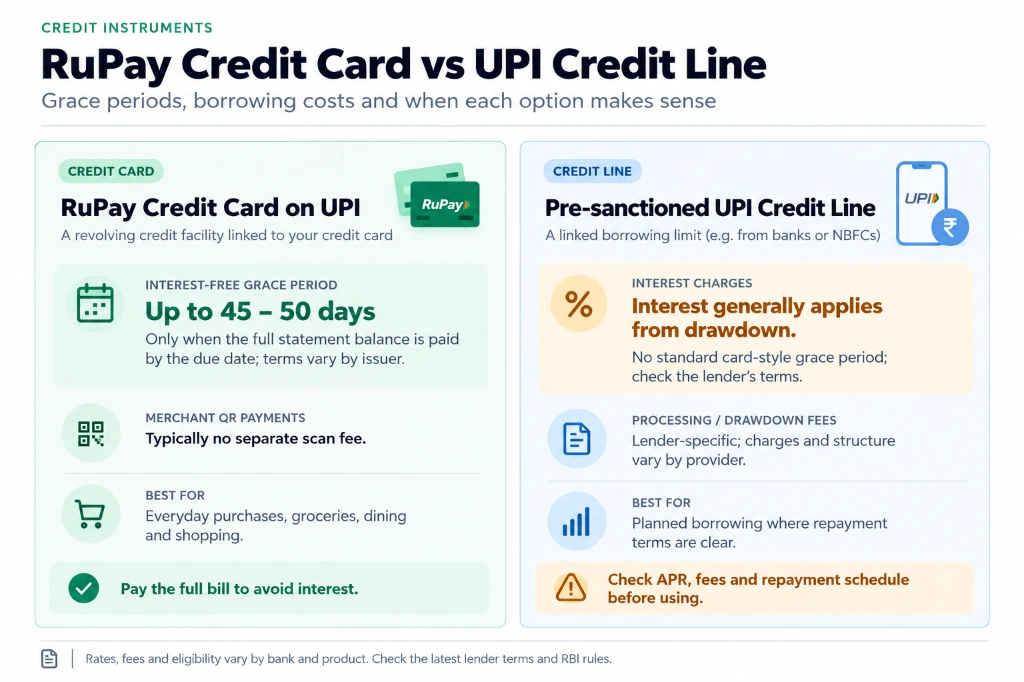
While payment apps display both options side-by-side during checkout, their legal definitions, interest start dates, and billing architectures are fundamentally different:
How RuPay Credit Cards on UPI Work
When you link an eligible RuPay credit card to a UPI app, transactions follow the traditional credit card billing engine governed by the RBI Master Direction on Credit and Debit Card – Issuance and Conduct Directions, 2022.
1. The 45 to 50-Day Interest-Free Window
Every credit card operates on a designated monthly billing cycle (e.g., 1st to 30th of every month) followed by a payment due date (typically 15 to 20 days after the statement generation date).
If you purchase goods on the 2nd day of your billing cycle and repay the Total Amount Due (TAD) on or before the due date, your finance charges are strictly ₹0. You effectively enjoy up to 48 or 50 days of interest-free capital.
2. When Does Card Interest Trigger?
Interest is charged on a credit card only when:
- You fail to pay the Total Amount Due by the payment due date.
- You choose to pay only the "Minimum Amount Due" (MAD).
- You withdraw cash from an ATM (cash advance).
Once triggered, card interest rates are steep—typically ranging between 36% and 42% Annual Percentage Rate (APR)—and interest is backdated to the transaction date. However, as long as you pay your statement in full every single month, credit card borrowing costs nothing.

How Pre-Sanctioned UPI Credit Lines Work
A pre-sanctioned credit line on UPI is not a revolving card product. It is an unsecured personal loan or running overdraft facility approved in advance by your bank based on your account history, salary inflows, and credit score.
Under RBI Circular RBI/2023-24/58 dated September 4, 2023, scheduled commercial banks are permitted to link these credit facilities directly to UPI handles.
1. The Day-One Daily Interest Mechanism
Unlike credit cards, bank credit lines operate on a daily reducing balance interest model:
Daily Interest Accrual = (Principal Outstanding × Annual Percentage Rate) ÷ 365
From the exact minute you scan a merchant QR code and draw down funds from the credit line, interest begins accumulating on that drawn balance every single day until the principal is repaid.
Note on Promotional Periods: A few banks offer introductory promotional "grace periods" (e.g., 15 days or 30 days zero interest on specific partner merchants) to encourage adoption. However, these are temporary marketing features, not statutory requirements. In the standard credit line agreement, there is no statutory grace period.
2. Drawdown and Processing Fees
In addition to daily interest, many banks levy an administrative "drawdown fee" or "convenience charge" every time you tap into the credit line. This typically ranges from 1% to 2.5% of the drawn amount or a flat fee of ₹50 to ₹250 per transaction, plus mandatory 18% GST.
Step-by-Step Mathematical Comparison: ₹25,000 Purchase
To illustrate the stark divergence between both instruments, let us calculate the full cost of financing a ₹25,000 retail purchase (such as home appliances or laptop repair) where the buyer repays the full balance after 30 days.
Scenario Assumptions:
- Transaction Amount: ₹25,000
- Repayment Horizon: Exactly 30 days after transaction
- RuPay Credit Card: 36% APR (if unpaid), 45-day interest-free grace period, Total Amount Due paid in full on day 30.
- UPI Credit Line: 18% APR, daily interest accrual from Day One, 1% drawdown fee, full principal repaid on day 30.
- Applicable GST: 18% on all interest charges and administrative fees under CBIC rules.
Advertisement
1. The RuPay Credit Card Math
Because the buyer settles the ₹25,000 balance on Day 30—well within the standard 45-day interest-free cycle:
- Accrued Interest: ₹0
- Processing / Drawdown Fee: ₹0
- GST on Finance Charges: ₹0
- Total Cost of Financing: ₹0
- Total Repayment Amount: ₹25,000
2. The UPI Credit Line Math
With the credit line, daily interest accrues on ₹25,000 at 18% APR over 30 days:
- Daily Interest Rate: 18% ÷ 365 = 0.049315% per day
- 30-Day Accrued Interest: ₹25,000 × 0.00049315 × 30 days = ₹369.86
- Upfront Drawdown Fee (1%): ₹25,000 × 0.01 = ₹250.00
- 18% GST on Interest: ₹369.86 × 18% = ₹66.57
- 18% GST on Drawdown Fee: ₹250.00 × 18% = ₹45.00
- Total GST Charges: ₹66.57 + ₹45.00 = ₹111.57
- Total Cost of Financing: ₹369.86 + ₹250.00 + ₹111.57 = ₹731.43
- Total Amount Paid by Borrower: ₹25,000 + ₹731.43 = ₹25,731.43
Repayment Comparison Summary
| Cost Component | RuPay Credit Card on UPI (Paid on Day 30) | UPI Credit Line (Repaid on Day 30) | Difference |
|---|---|---|---|
| Principal Drawn | ₹25,000.00 | ₹25,000.00 | ₹0.00 |
| Contracted APR | 36.00% (Deferred) | 18.00% (Day-One) | -18.00% |
| Accrued Interest | ₹0.00 | ₹369.86 | +₹369.86 |
| Upfront Drawdown Fee | ₹0.00 | ₹250.00 (1%) | +₹250.00 |
| 18% GST on Charges | ₹0.00 | ₹111.57 | +₹111.57 |
| Total Borrowing Cost | ₹0.00 | ₹731.43 | +₹731.43 |
| Effective Monthly Cost | 0.00% | 2.926% | +2.926% |
Even though the credit line advertises an "attractive" 18% APR—half the 36% APR of a credit card—it costs ₹731.43 more for a 30-day loan because it lacks the interest-free grace period and carries transaction fees.
The Key Fact Statement (KFS) Audit: 6 Questions to Inspect
Under RBI Master Directions, every regulated bank offering a credit facility must provide an upfront Key Fact Statement (KFS) written in plain language. Before activating or drawing from a UPI Credit Line, inspect these six fields:
- Daily Interest Accrual Clause: Does the KFS state that interest begins on the date of transaction or after a statement cycle?
- Annual Percentage Rate (APR): What is the all-inclusive APR, factoring in compounding, processing fees, and documentation costs?
- Drawdown / Tranche Fee: Does the bank deduct a fee every time you scan a QR code, or only on the initial activation of the credit line?
- Prepayment and Foreclosure Penalties: Under RBI rules, floating-rate personal loans to individual borrowers cannot carry foreclosure charges. Ensure the KFS specifies zero prepayment penalty for early settlement.
- Impact on CIBIL / Experian Credit Reports: UPI Credit Lines are reported to credit bureaus as Unsecured Personal Loans / Overdraft Facilities. Multiple micro-drawdowns can clutter your credit report with numerous active trade lines.
- Default Interest Spread: If you miss a scheduled repayment date, what penal rate is added on top of the contracted APR?
Strategic Decision Matrix: Which Instrument Should You Use?
To optimize your cash flow and avoid unnecessary financial friction, follow this practical operational framework:
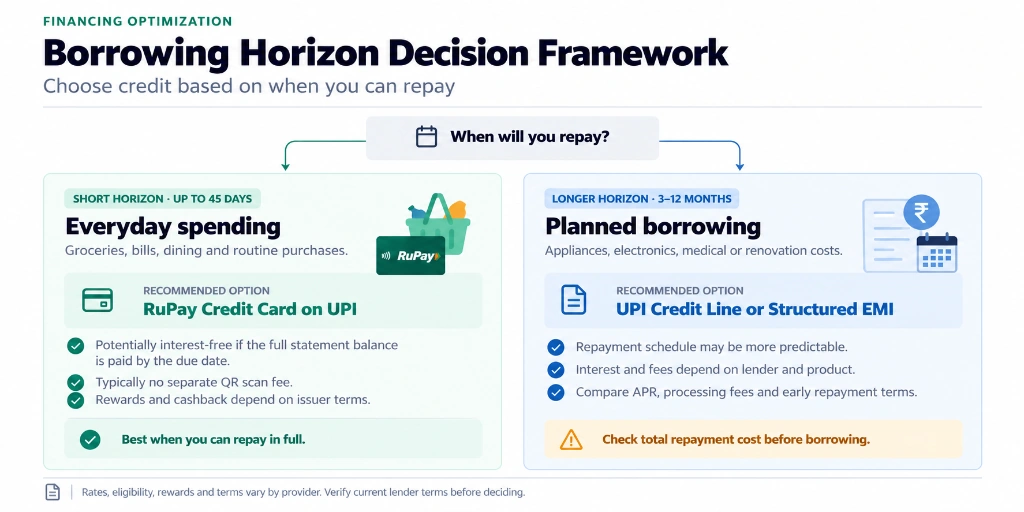
- Use RuPay Credit Card on UPI if: You plan to repay the full bill within 30 to 45 days. You maximize interest-free liquidity, accumulate reward points, and avoid drawdown charges.
- Use UPI Credit Line if: You need to borrow for 3 to 12 months, your credit card limit is exhausted, and the bank offers a lower structured loan APR (14% to 18%) compared to card revolving rates (36% to 42%).
Disclaimer: This article is for educational and informational purposes only and does not constitute credit, legal, or financial advice. Loan terms, interest rates, and fees vary across banks; always read your Key Fact Statement (KFS) thoroughly before entering into any borrowing contract.
Advertisement