

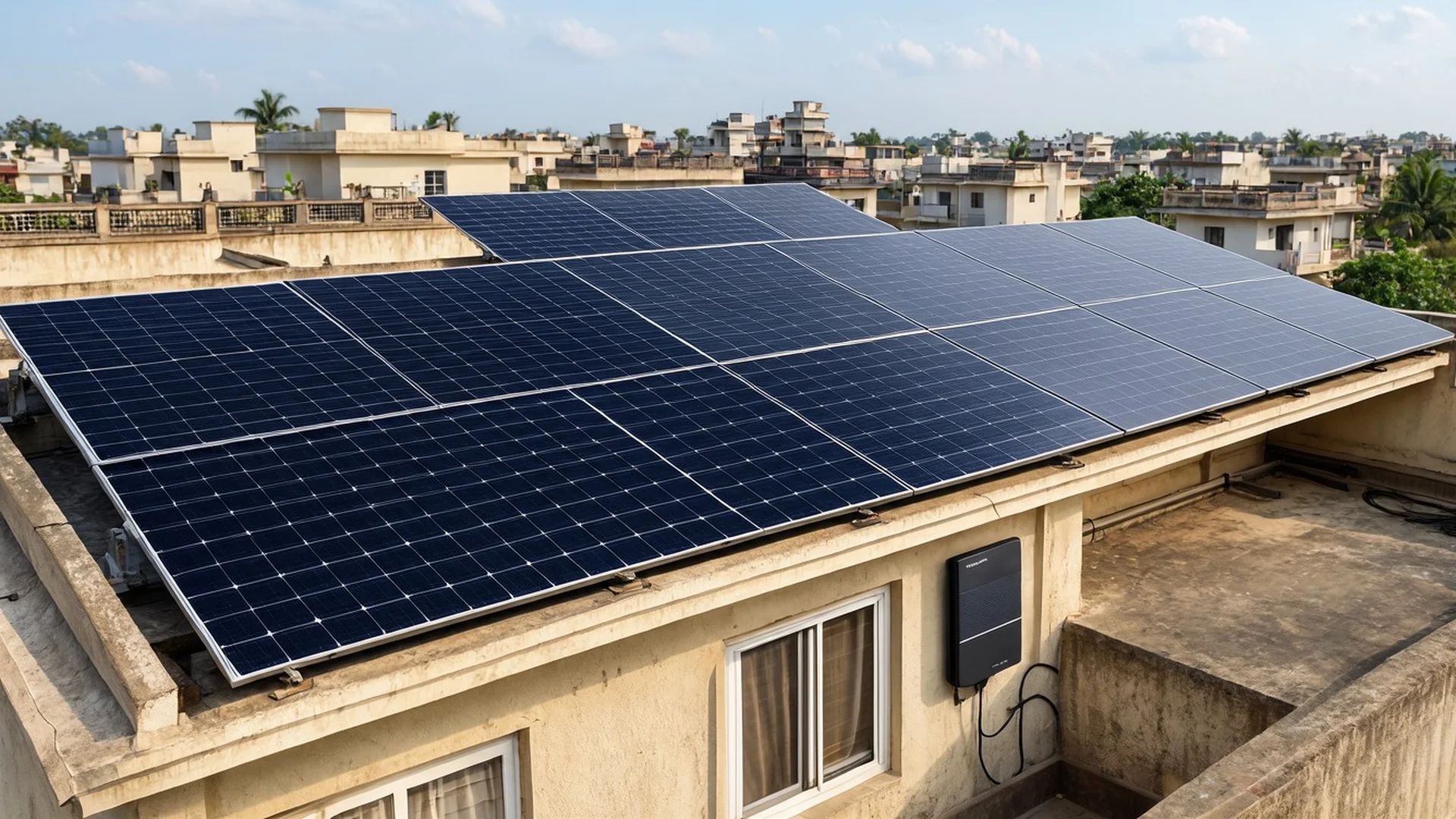
Every week across Indian housing colonies, empanelled solar vendors hand homeowners a tidy one-page quotation for a 3 kW on-grid rooftop plant: "Total cost ₹1,75,000, government subsidy ₹78,000, your net cost ₹97,000, electricity bill ₹0 forever."
Under the PM Surya Ghar: Muft Bijli Yojana—where eligible residential consumers receive ₹30,000 per kW for the first 2 kW plus ₹18,000 for the third kW, capped at ₹78,000—the headline math is genuinely attractive.
As of 21 November 2026, however, examining state electricity regulatory commission (SERC) fee schedules, DISCOM commissioning workflows, and 25-year component lifecycles reveals five real-world line items that rarely appear on a sales brochure.
Between a 45-to-90-day net-metering wait that delays both bill savings and subsidy release, bidirectional smart-meter and load-enhancement fees, non-waivable monthly fixed charges, and an inevitable Year-10 to Year-12 string inverter replacement, the true lifecycle cost of a 3 kW plant is meaningfully higher than the Day-1 net invoice—even though it remains one of the strongest household investments in India once budgeted honestly.
1. The Policy & Operational Context: Five Line Items Missing From Standard 3 kW Quotes
Vendors quote strictly what they supply and bolt onto your roof: Domestic Content Requirement (DCR) solar panels, a 3 kW on-grid string inverter, a basic low-rise mounting structure, AC/DC cabling, and earthing. Five operational and lifecycle costs sit outside that standard invoice:
- The 45-to-90-Day Net-Metering & Subsidy Wait (Dead Cash Period): Under the PM Surya Ghar workflow, your ₹78,000 Central Financial Assistance (CFA) is not deducted upfront at purchase; it is credited via Direct Benefit Transfer (DBT) only after the local DISCOM installs the bidirectional net meter, inspects the plant, and uploads the commissioning certificate. While the Electricity (Rights of Consumers) Rules, 2020 set a 15-day floor for DISCOM action and mandate minimum compensation of ₹500 per day for unjustified delay (with Karnataka's BESCOM setting officer liability at ₹1,000/day for 1–10 kW domestic systems), real-world friction routinely stretches the gap. DISCOM technical feasibility takes 7 to 21 days, and post-installation net-meter commissioning takes another 15 to 30 days—plus an extra 15 to 30 days if the vendor's Single Line Diagram (SLD) does not match the as-built wiring. During those two to three months, your full ₹1,75,000 is already paid out (or accruing loan interest), your panels sit switched off or uncredited, and you keep paying full grid bills.
- Bidirectional Meter, Application & Sanctioned-Load Enhancement Fees: Most state DISCOMs cap residential net-metering capacity at 80% to 100% of your existing sanctioned load. If your home connection currently sits on a 1 kW or 2 kW sanctioned load, you must pay DISCOM load-enhancement charges and security deposits to upgrade to 3 kW before feasibility is cleared. On top of that, states such as Telangana (₹2,500 LT application fee plus bidirectional AMI smart meter at prosumer cost) and West Bengal (₹1,000 LV fee, though government-funded schemes are exempt, plus prosumer-funded net and generation meters) bill metering and documentation separately—typically adding ₹4,000 to ₹10,000 outside the base EPC quote.
- The Year-10 to Year-12 String Inverter Replacement: Solar panels carry 25-year performance warranties, which leads buyers to assume the entire plant lasts 25 years untouched. In reality, the on-grid string inverter—packed with heat-sensitive capacitors and power electronics—carries a standard 5-to-7-year warranty and a practical Indian rooftop lifespan of 8 to 12 years. Replacing a 3 kW single-phase string inverter in Year 10–12 costs roughly ₹15,000–₹18,500 for bare entry-level hardware up to ₹25,000–₹32,000 for mid-tier branded units plus GST (up to 18% on standalone supply) and ₹4,000–₹6,000 in removal and recommissioning labour—a predictable ₹25,000 to ₹35,000 mid-life expense.
- Elevated Terrace Structures & Civil Waterproofing: Standard ₹1.65L–₹1.75L quotes include a low-rise mounting frame (approx. 2–3 feet off the slab) that renders 250–300 sq ft of your terrace unusable. Upgrading to a 7-to-8-foot hot-dip galvanised elevated pergola structure so your family can still walk or dry clothes underneath adds ₹15,000 to ₹25,000 plus terrace waterproofing sealant.
- Fixed Monthly Demand Charges & Low Annual Surplus Rates (Why Your Bill Is Never ₹0): Net metering offsets energy charges (₹/kWh), not monthly fixed/sanctioned-load charges (typically ₹100 to ₹150 per kW per month, or ₹300–₹450/month on a 3 kW connection). Worse, if you oversize a 3 kW plant (generating approx. 360–450 units/month) for a home consuming only 200 units/month, your leftover annual surplus on 31 March is settled at the state's low Average Power Purchase Cost (APPC) or generic tariff—just ₹2.25/kWh in Gujarat, ₹2.00–₹2.50/kWh in Uttar Pradesh, ₹2.70/kWh in West Bengal, ₹2.82/kWh in Maharashtra, and ₹3.10–₹3.40/kWh in Haryana/Rajasthan.
2. The Vendor Quote vs. Reality Table: Every Hidden Cost Mapped (India, Nov 2026)
Before signing a vendor's "all-inclusive" booking form, audit these six line items side by side:
| Cost / Friction Line Item | What the Vendor Brochure Usually Says | What Actually Happens on Your Roof & Bill (2026) | Realistic Rupee Impact (3 kW Plant) |
|---|---|---|---|
| 1. Net-Metering & DBT Subsidy Wait | "Instant savings; ₹78,000 subsidy in 30 days" | 45–90 days from installation to DISCOM net-meter commissioning & DBT credit | ₹5,200 – ₹9,500 in lost grid savings + opportunity/loan interest (OneMint calculation) |
| 2. DISCOM Fees, Meter & Load Upgrade | "Documentation support included" | Prosumer pays bidirectional AMI meter, application fee & 1–2 kW load upgrade | ₹5,000 – ₹12,000 one-time DISCOM outlay |
| 3. String Inverter Replacement (Yr 10–12) | "25-year system life" | Panels last 25 yrs; string inverter needs 1 replacement around Year 10–12 | ₹25,000 – ₹35,000 (hardware + GST + recommissioning labour) |
| 4. Elevated Structure & Waterproofing | "Standard GI structure included" | Low-rise frame blocks 250–300 sq ft of terrace; elevated pergola costs extra | ₹15,000 – ₹25,000 (optional, if keeping terrace usable) |
| 5. Fixed Charges & Dust Cleaning (O&M) | "Zero electricity bill & zero maintenance" | Fixed load charges remain; dusty North India/metro roofs need fortnightly washing | ₹3,600 – ₹5,400/yr fixed bill (not avoided) + ₹1,500 – ₹3,000/yr cleaning |
| 6. Annual Net-Surplus Settlement Haircut | "Sell extra power back to the grid" | Net surplus at 31 March settles at APPC (₹2.25–₹3.40/kWh), not retail ₹7–₹8/kWh | Cuts ROI sharply if plant is oversized above annual household usage |
3. Worked Rupee Math: Vendor Brochure Payback (3.0 Years) vs. Real All-In Lifecycle Cost
To see how much these unquoted items actually shift your numbers—without exaggerating them into a reason to avoid solar—let us compare the Vendor Brochure Quote against the Real-World All-In 3 kW Ledger for a typical urban Indian household.
Baseline Parameters & Assumptions (November 2026 India Benchmarks, All Figures in INR)
- Base 3 kW On-Grid Quote (DCR Panels + BIS Inverter + Standard Structure): ₹1,75,000 (midpoint of India's ₹1.60L–₹1.90L retail band); PM Surya Ghar CFA = ₹78,000; Vendor Brochure Net Cost = ₹97,000.
- Annual Generation & Retail Tariff: 4,200 kWh/year (350 units/month, within India's 360–450 unit/month 3 kW band, accounting for approx. 0.5% annual panel degradation over time) offsetting a retail energy tariff of ₹7.50/kWh = ₹31,500/year (₹2,625/month) in energy-charge savings.
- Unquoted Day-1 & Commissioning Costs (Real-World Case):
- DISCOM net-meter, processing fee, and 1 kW sanctioned-load upgrade: ₹8,000.
- Elevated terrace structure upgrade (optional—tracked separately): ₹18,000.
- 75-Day Net-Metering & DBT Wait (2.5 Months): 2.5 months of foregone solar savings (2.5 × ₹2,625 = ₹6,563) plus 2.5 months of carrying interest on the ₹78,000 pending DBT subsidy at 7.0% p.a. opportunity cost (₹1,138).
- Mid-Life & Recurring Lifecycle Costs:
- Year-10 String Inverter Replacement (mid-tier 3 kW hardware ₹22,000 + 18% standalone GST ₹3,960 + ₹4,040 removal/recommissioning labour): ₹30,000 (within the ₹20,000–₹35,000 2026 replacement band).
- Annual panel cleaning & basic inspection (DIY/gardener + water): ₹2,000/year (reducing Year-1 net savings from ₹31,500 to ₹29,500/year).
- Present Value Check (at 8.5% Discount Rate): ₹30,000 spent in Year 10 equals ₹13,269 in today's rupees (₹30,000 ÷ 1.085^10) (OneMint calculation).
Plain-Text Formulas Used
- Vendor Brochure Payback = (₹1,75,000 − ₹78,000) ÷ ₹31,500/year
- Real Upfront Net Cost (Standard Roof) = ₹97,000 + DISCOM/Load Fees (₹8,000) + 75-Day Wait Loss (₹7,701)
- Real Simple Payback (Before Year-10 Inverter) = Real Upfront Net Cost ÷ Net Annual Savings (₹29,500)
- 15-Year Cumulative Net Profit = (15 × ₹29,500) − Real Upfront Net Cost − Year-10 Inverter (₹30,000)
Line-by-Line Arithmetic
Vendor Brochure Math (Zero Delays, Zero Extra Fees, Zero Maintenance)
- Net Outlay: ₹1,75,000 − ₹78,000 = ₹97,000.
- Brochure Payback: ₹97,000 ÷ ₹31,500 = 3.08 years (OneMint calculation).
Advertisement
Real-World Math — Standard Low-Rise Roof (Adding DISCOM Fees, 75-Day Wait & ₹2,000/yr Cleaning)
- 75-Day Net-Metering & Subsidy Wait Drag: ₹6,563 (lost generation) + ₹1,138 (DBT carry cost) = ₹7,701 (OneMint calculation).
- Effective Day-1 Net Capital Committed: ₹97,000 + ₹8,000 (DISCOM/meter/load) + ₹7,701 (wait drag) = ₹1,12,701 (OneMint calculation).
- Net Annual Cash Savings (After ₹2,000/yr cleaning): ₹31,500 − ₹2,000 = ₹29,500/year (OneMint calculation).
- Real Simple Payback (Standard Roof): ₹1,12,701 ÷ ₹29,500 = 3.82 years (+0.74 years, or approx. 9 months longer than the brochure) (OneMint calculation).
- If Adding an ₹18,000 Elevated Terrace Structure: Effective capital rises to ₹1,30,701, lifting simple payback to 4.43 years (OneMint calculation).
Accounting for the Year-10 Inverter Replacement (₹30,000 Out-of-Pocket in Year 10)
- Total Unquoted Costs Over 10–12 Years (Standard Roof): ₹8,000 (DISCOM) + ₹7,701 (wait drag) + ₹30,000 (Year-10 inverter) + ₹20,000 (10 yrs cleaning) = ₹65,701 (or ₹83,701 with an elevated structure) (OneMint calculation).
- 15-Year Cumulative Net Cash Profit (Standard Roof, Constant Tariff, After Inverter Replacement): (15 × ₹29,500 = ₹4,42,500) − ₹1,12,701 − ₹30,000 = +₹2,99,799 net profit — even after paying every single hidden cost (OneMint calculation).
[!IMPORTANT] Variance Callout: Unquoted DISCOM/meter fees (₹8,000), a 75-day net-metering wait (₹7,701), annual cleaning (₹2,000/yr), and a Year-10 inverter replacement (₹30,000) add ₹65,701 over the first decade—stretching real payback from the vendor's 3.08 years to 3.82 years (4.43 years with an elevated terrace frame), yet the 3 kW plant still clears ₹2,99,799 in net 15-year cash profit (OneMint calculation).
Note on Constants: Constants used are ₹1,75,000 base 3 kW quote, ₹78,000 PM Surya Ghar CFA, 4,200 kWh/yr generation at ₹7.50/kWh, 75-day net-metering delay, and a ₹30,000 Year-10 inverter replacement. Compare this pure on-grid math with adding a 5 kWh battery in OneMint's PM Surya Ghar Battery Maths (3.3 to 9 Years).
4. Warranty Traps & What We Don't Know Yet
Two subtle technical details determine whether your Year-10 inverter replacement actually happens in Year 11—or prematurely in Year 4:
- Extended Inverter Warranties Rarely Beat Self-Funding: Vendors frequently pitch a ₹12,000 to ₹15,000 extended warranty on Day 1 to stretch inverter coverage from 5 years to 10 years. As 2026 lifecycle financial modelling shows, the present value of a ₹30,000 replacement in Year 10 at an 8.5% discount rate is just ₹13,269 (OneMint calculation)—meaning an expensive upfront extended warranty can cost more in today's rupees than simply parking ₹15,000 in a safe debt instrument and paying for a newer, higher-efficiency inverter a decade later.
- Voltage Fluctuations Void Cheap Inverter Warranties: In semi-urban and tier-2 feeders where summer afternoon grid voltage spikes past 253V–260V, on-grid inverters trip repeatedly into over-voltage protection—cutting generation and stressing internal components. Always confirm your vendor installs proper AC/DC Surge Protection Devices (SPDs) and dedicated copper/chemical earthing pits rather than skipping them to shave ₹4,000 off the quote.
What We Don't Know Yet
- State-Level Enforcement of the ₹500/Day DISCOM Delay Penalty: Although Rule 11(12) of the Electricity (Rights of Consumers) Rules, 2020 mandates at least ₹500/day compensation for unjustified DISCOM net-metering delays, automated credit of this penalty onto consumer bills remains rare unless homeowners escalate formally through the portal grievance route or the Consumer Grievance Redressal Forum (CGRF).
- Future Residential Net-Metering Settlement Reforms: As residential solar penetration deepens across Gujarat, Maharashtra, and Kerala, State Electricity Regulatory Commissions periodically review annual surplus APPC rates and fixed demand charges—which can trim marginal savings slightly over a 25-year horizon.
5. What This Does NOT Mean
- It does NOT mean the ₹78,000 PM Surya Ghar subsidy is a scam: Even after adding ₹65,701 in unquoted DISCOM, delay, cleaning, and inverter-replacement costs, a 3 kW on-grid plant still pays back in under 4 years and delivers an effective post-tax return far above bank fixed deposits.
- It does NOT mean you should buy the cheapest ₹1,45,000 quote: Ultra-low quotes routinely cut corners on thin non-galvanised mounting channels, undersized DC cables, missing lightning arresters, or non-DCR modules that get your ₹78,000 subsidy rejected outright.
- It does NOT mean you should oversize to 5 kW "just in case": Remember that central CFA is strictly capped at ₹78,000 for 3 kW and above, and excess annual units settle at just ₹2.25–₹3.40/kWh. Size strictly to your last 12 months' average monthly units (roughly 350–400 units/month for a 3 kW plant).
6. Actionable Step-by-Step Homeowner Audit: Five Clauses to Put in Writing Before Paying an Advance
Before transferring a booking token to any portal-empanelled vendor, demand these five written confirmations on the quotation:
- Itemise Every DISCOM & Metering Fee Explicitly: Ask the vendor to list "DISCOM Application Fee, Bidirectional Smart Meter Cost, Sanctioned Load Upgrade Fee, and Liaison Charges" as separate lines—explicitly marked "Included" or "Payable directly by homeowner to DISCOM."
- Verify Your Sanctioned Load & DCR/ALMM Compliance Before Gate 1: Check your latest electricity bill to confirm your Sanctioned Load is at least 3 kW (or initiate load enhancement first) and ensure your consumer name matches your government ID to prevent portal rejection delays. Confirm in writing that panels are both ALMM-listed and DCR-certified (mandatory for PM Surya Ghar CFA).
- Tie Final Vendor Payment to Net-Meter Commissioning—Not Roof Mounting: Never pay 100% of the contract value the day panels are bolted onto the terrace. Structure milestones cleanly (for example, 20% on feasibility approval, 60% on material delivery and mounting, and 20% held back until the DISCOM net meter is installed, the as-built SLD passes inspection, and the commissioning certificate is uploaded on pmsuryaghar.gov.in).
- Lock In Structure Height & Inverter Efficiency Specs: Specify exact structure height (standard low-rise vs. 7-foot elevated hot-dip galvanised GI), wind-speed rating, AC/DC SPD and earthing count, and confirm the 3 kW inverter meets India's 95% minimum efficiency requirement for 3 kW–5 kW inverters (2026–27).
- Budget Your Liquidity & Loan Ceiling Cleanly: Keep at least ₹15,000–₹20,000 in liquid cash for DISCOM fees and the 75-day subsidy wait, keep any PM Surya Ghar bank loan at or below ₹2,00,000 to stay in the 6.00% concessional slab, and plan your household cash flow using OneMint's Home Loan EMI Calculator and Financial Health Quiz.
Related OneMint explainers: PM Surya Ghar Battery Maths: Why Adding Storage Stretches Payback From 3.3 to 9 Years, After the First Rate Hike in Nearly Four Years: A Four-Rung FD Ladder, and Your Next EMI Reset May Carry Two Rate Hikes, Not One.
[!NOTE] Disclaimer: Educational content only. OneMint is not a SEBI-registered investment adviser. Nothing in this article constitutes equipment endorsement, architectural consultation, or credit underwriting advice. Solar equipment prices, DISCOM net-metering regulations, public bank loan terms, and central CFA rules change periodically; always verify final contract quotes and portal approvals before signing. For broader financial goal planning, try OneMint's interactive SIP Calculator and Financial Health Quiz.
Source List & Citations
- Ministry of Power, Government of India: Electricity (Rights of Consumers) Rules, 2020 (Rule 11(12)) — 15-day DISCOM timeline floor and ₹500/day minimum compensation for unjustified net-metering delay (cited via 2026 state net-metering regulatory audit, 31 October 2026).
- State Electricity Regulatory Commissions (SERCs) & DISCOM Schedules (2026): GERC (Gujarat), MERC (Maharashtra), KERC/BESCOM (Karnataka), TGERC (Telangana), WBERC (West Bengal), DERC (Delhi), and UPERC/RERC residential net-metering charges and annual APPC/generic surplus settlement rates (₹2.25–₹3.40/kWh).
- Ministry of New and Renewable Energy (MNRE): PM Surya Ghar: Muft Bijli Yojana (pmsuryaghar.gov.in) — ₹78,000 CFA ceiling for 3 kW+, 5-gate commissioning workflow, and ALMM/DCR compliance rules. URL: https://pmsuryaghar.gov.in/
- Indian Solar Hardware & Lifecycle Cost Benchmarks (April–November 2026): 3 kW on-grid component pricing (₹1.60L–₹1.90L gross, 31 October 2026); 3 kW string inverter replacement cost (₹15,000–₹18,500 bare hardware; ₹20,000–₹35,000 installed lifecycle budget, 14 November 2026) and 95% minimum efficiency norm for 3–5 kW inverters (2026–27).
Advertisement