

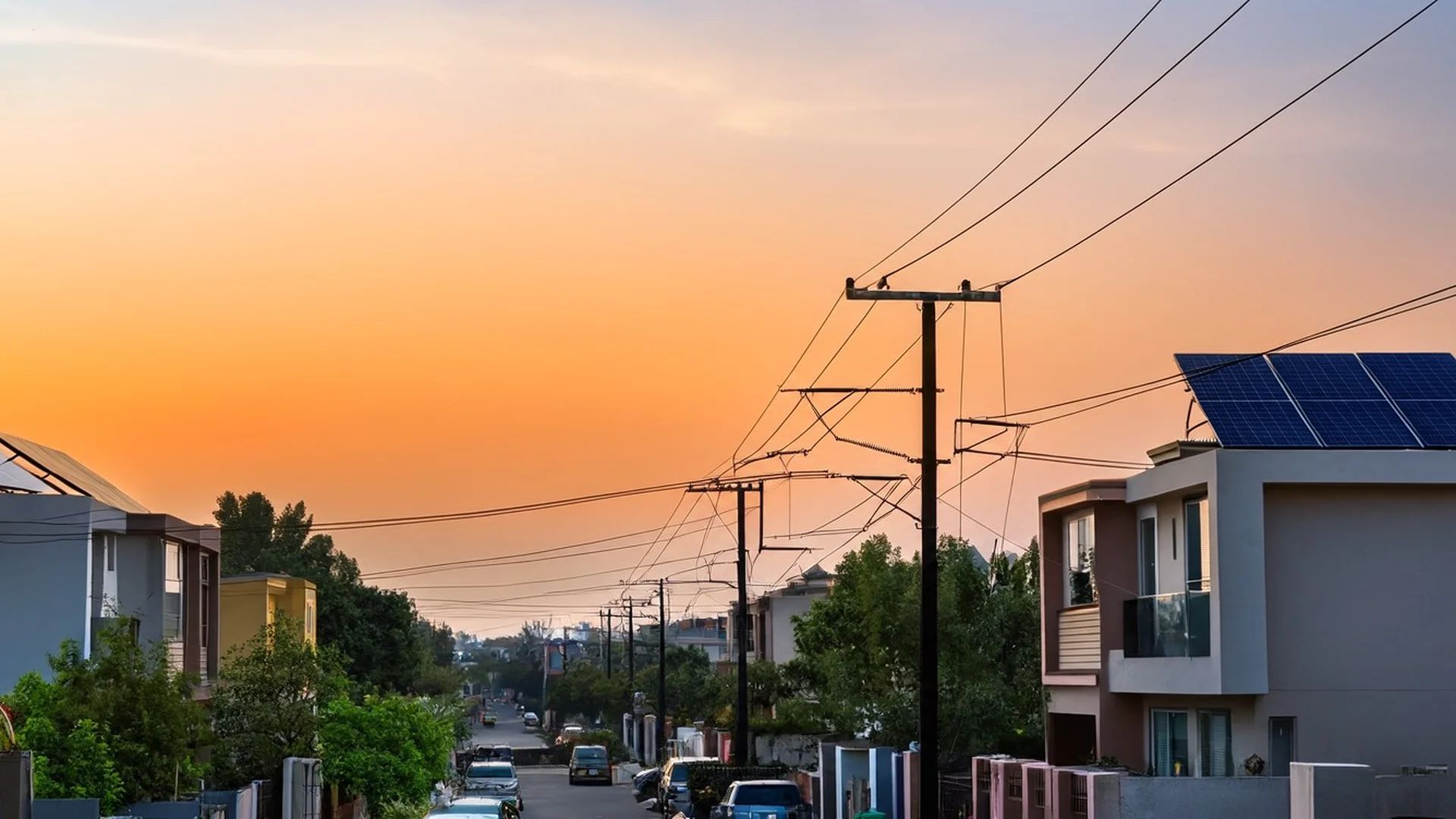
When an urban Indian family installs a 5 kW rooftop solar system under PM Surya Ghar: Muft Bijli Yojana and watches its monthly electricity bill crash from ₹5,150 to ₹500, the saving feels entirely self-contained. You generate your own units on your own roof, export midday surplus to the local utility, and pull power back at night.
As of November 2026, about 65 lakh households across India have been solarised under the scheme, with over 21 lakh already receiving zero electricity bills and ₹28,024 crore disbursed in central subsidies through July 2026.
What almost no solar vendor explains at the point of sale is how India's electricity grid is financed underneath your bi-directional meter. Indian distribution companies (DISCOMs) do not charge every customer the true cost of delivering power. Instead, they run a fragile cross-subsidy pyramid: commercial shops, factories, and high-consumption urban homes pay well above the national Average Cost of Supply (₹7.10/kWh) so that lifeline domestic users and agricultural pumps can pay far below cost—while fixed grid wires, transformers, and thermal capacity charges are bundled mostly into per-unit energy rates rather than monthly fixed charges.
When high-paying rooftop households zero out their metered units while still relying on the grid as a free 24x7 battery, the utility's fixed costs and cross-subsidy obligations do not vanish. They shift onto four specific groups—non-solar neighbours, renters in apartments, commercial users, and state taxpayers—and they are already triggering the tariff and net-metering rule changes rolling across Indian states in 2026 (all DISCOM benchmarks, regulatory orders, and calculations below are current as of 21 November 2026).
1. How India's Power Cross-Subsidy Pyramid Actually Works
To understand why going solar creates a fiscal ripple, look at two structural numbers published by Indian power agencies in 2026:
- The Slab & Sector Cross-Subsidy Gap: On a gross input basis across Indian utilities, the national Average Cost of Supply (ACS) sits at ₹7.10/kWh against an Average Revenue Realised (ARR, subsidy included) of ₹7.04/kWh—a narrow ₹0.06/kWh gap that helped DISCOMs post a slim collective profit of ₹2,701 crore for the first time. Yet that razor-thin headline average hides extreme cross-subsidies underneath, alongside ₹3 trillion in regulatory assets, ₹7.4 trillion in debt, and ₹2.2 trillion in projected state tariff subsidies. In Maharashtra (MSEDCL's FY 2025-26 MERC tariff order), below-poverty-line households pay ₹1.48/kWh and 1–100 unit homes pay ₹5.74/kWh (energy plus wheeling), whereas 301–500 unit homes pay ₹16.85/kWh and above 500 unit homes pay ₹19.15/kWh—nearly three times the national supply cost—while commercial users average up to ₹14.72/kWh.
- The Fixed-Cost Recovery Trap: According to a May 2026 Central Electricity Authority (CEA) report, fixed costs—thermal power-plant capacity charges, transmission lines, employee salaries, and transformer upkeep—account for 38% to 56% of a DISCOM's Annual Revenue Requirement (ARR), yet monthly fixed charges collect only 9% to 20% of total utility revenue. The remaining fixed network cost is hidden inside per-unit variable tariffs.
That design creates an unintended paradox: the exact households most able to afford rooftop solar—homeowners with private terraces, 3 kW–5 kW+ loads, and summer AC usage—are the very residential cross-subsidisers keeping the local feeder solvent. By July 2026, over 35.97 lakh of 40.07 lakh recorded PM Surya Ghar installations were sized above 3 kWp.
2. Step-by-Step Mathematical Comparison: The Hidden ₹30,240 Annual Cost Shift on One 5 kW Home
Let us trace every rupee on a single high-consumption urban household switching to rooftop solar—comparing 1:1 Net Metering, the Undersized Double-Subsidy Trap, and Net Billing.
Simulation Parameters
- Household Profile: Urban independent home consuming 600 kWh/month (7,200 kWh/year), with a 5 kW sanctioned load (40% daytime load = 240 kWh; 60% evening/night load = 360 kWh).
- Representative Telescopic Tariff (Calibrated to National ₹7.10/kWh ACS):
- 0–100 units: ₹3.50/kWh
- 101–200 units: ₹6.00/kWh
- 201–400 units: ₹8.50/kWh
- Above 400 units: ₹10.00/kWh
- Monthly Fixed Charge: ₹500/month (₹100/kW; 9.7% of pre-solar bill, sitting directly inside the CEA's 9%–20% national range).
- DISCOM True Cost Split: ₹7.10/kWh national ACS split 50/50 into ₹3.55/kWh fixed grid/capacity costs (within CEA's 38%–56% band) and ₹3.55/kWh average variable power purchase (or ₹2.80/kWh daytime marginal solar-hour avoided cost to isolate Time-of-Day arbitrage).
- Pre-Solar Baseline:
- Monthly Bill = (100 × ₹3.50) + (100 × ₹6.00) + (200 × ₹8.50) + (200 × ₹10.00) + ₹500 = ₹5,150/month (₹61,800/year; effective rate ₹8.58/kWh) (OneMint calculation).
- DISCOM Cost to Serve 600 kWh = ₹2,130 variable + ₹2,130 fixed = ₹4,260/month (₹51,120/year) (OneMint calculation).
- Pre-Solar Cross-Subsidy Contributed: ₹5,150 − ₹4,260 = +₹890/month (+₹10,680/year) (OneMint calculation).
Formulas Used
- DISCOM Net Annual Shortfall (₹) = 12 × (Household Bill Reduction − Utility Avoided Variable Power Cost)
Arithmetic Outcomes (OneMint Calculation)
Scenario A — Right-Sized 5 kW Solar Under 1:1 Net Metering (600 kWh Generated → 0 Net Units)
- Household pays fixed charge only: ₹500/month (saves ₹4,650/month = ₹55,800/year).
- DISCOM's ₹2,130/month fixed network/capacity cost remains stranded.
- Flat-Cost Baseline (₹3.55/kWh avoided = ₹2,130/mo): DISCOM's account swings from +₹890 surplus to −₹1,630 deficit—a net revenue shortfall of ₹4,650 − ₹2,130 = ₹2,520/month (₹30,240/year) (OneMint calculation).
- Time-of-Day Reality (₹2.80/kWh daytime avoided = ₹1,680/mo): Because daytime solar exports displace cheaper midday power while the household still imports expensive evening peak power, the DISCOM's net shortfall climbs to ₹4,650 − ₹1,680 = ₹2,970/month (₹35,640/year) (OneMint calculation).
Scenario B — Undersized 4 kW System (480 kWh Generated → 120 Net Units Left on Bill)
- Under telescopic slabs, the household erases its expensive ₹10.00 and ₹8.50 slabs first, paying only (100 × ₹3.50) + (20 × ₹6.00) + ₹500 = ₹970/month (saving ₹4,180/month, or 89.9% of its energy bill with an 80% solar offset) (OneMint calculation).
- Worse, the remaining 120 units are billed at an average energy rate of just ₹3.92/kWh—meaning the affluent household now draws a subsidised low-slab tariff after already pocketing the ₹78,000 PM Surya Ghar subsidy.
- DISCOM Shortfall: ₹4,180 − (480 × ₹3.55) = ₹2,476/month (₹29,712/year flat; ₹34,032/year with daytime ToD spread)—causing 98.3% of the full 5 kW utility loss while sizing smaller (OneMint calculation).
Scenario C — 5 kW Solar Under Net Billing (Exports Paid ₹3.00/kWh Feed-in Tariff; Imports Billed Normally)
- Household self-consumes 240 kWh during the day, imports 360 kWh in the evening (bill: ₹350 + ₹600 + ₹1,360 = ₹2,310), and gets ₹1,080 credit for 360 kWh exported at ₹3.00/kWh → Net Bill = ₹1,230 + ₹500 = ₹1,730/month (saves ₹3,420/month = ₹41,040/year).
- DISCOM Shortfall: Drops to ₹3,420 − ₹2,130 = ₹1,290/month (₹15,480/year flat; ₹20,880/year with ToD)—slashing utility revenue erosion by 41% to 49% while preserving healthy consumer returns (OneMint calculation).
| Metering / Sizing Regime (600 kWh/mo Home, ₹7.10/kWh ACS) | Household Monthly Bill | Household Annual Saving | DISCOM Annual Shortfall (Flat ₹3.55 Avoided) | DISCOM Annual Shortfall (Daytime ₹2.80 ToD) | Consumer Payback Band (CSEP) |
|---|---|---|---|---|---|
| Pre-Solar Baseline | ₹5,150 | — | +₹10,680 surplus | +₹10,680 surplus | — |
| A: 5 kW — 1:1 Net Metering | ₹500 | ₹55,800 | -₹30,240 | -₹35,640 | 4–5 yrs (21–28% IRR) |
| B: 4 kW Undersized — Net Metering | ₹970 | ₹50,160 | -₹29,712 (double subsidy) | -₹34,032 | Fastest slab-arbitrage drop |
| C: 5 kW — Net Billing (₹3.00 FiT) | ₹1,730 | ₹41,040 | -₹15,480 (-48.8%) | -₹20,880 (-41.4%) | 6–9 yrs |
[!IMPORTANT] Variance Callout: On a single feeder of 100 households, if 10 affluent homes shift to 5 kW 1:1 net metering—creating ₹3,02,400/year in unrecovered utility costs (₹3,56,400/year with ToD)—spreading that hole across the remaining 90 non-solar homes (averaging 250 kWh/month = 2,70,000 kWh/year) requires raising their tariffs by ₹1.12 to ₹1.32 per unit, adding ₹3,360 to ₹3,960 per year to every non-solar family's bill (OneMint calculation).
Advertisement
3. Who Actually Pays the Tab: Four Groups Absorbing the Rooftop Shift
Because state electricity regulators must eventually balance each DISCOM's Annual Revenue Requirement (ARR), unrecovered fixed costs and lost cross-subsidies settle across four real pockets:
- Renters and Multi-Storey Apartment Residents: As a 30 October 2026 CEEW analysis highlights, tenants and flat owners in dense Indian cities generally lack exclusive roof ownership and cannot install individual net-metered plants unless Virtual Net Metering (VNM) or shared community solar scales. When base tariffs or fixed charges rise to plug utility deficits, non-solar apartment families pay the increase without any route to offset it.
- State Taxpayers (The Double-Subsidy Bill): In states offering 100 to 300 free or heavily subsidised domestic units, an October 2026 CEEW study warned that households undersizing their rooftop plants to slip into subsidised slabs collect both the ₹78,000 central capital grant and recurring state tariff subsidies—creating a potential cumulative nationwide fiscal burden of up to ₹1 lakh crore. Meanwhile, the Centre's ₹4,950 crore DISCOM incentive pool under PM Surya Ghar (whose operational guidelines MNRE updated on 30 July 2026, paying 5%–10% of benchmark cost for additions above 10%–15% of base capacity) is a one-time payment against a permanent 25-year revenue drop.
- Small Shops and Factories Without Roofs: Commercial and industrial (C&I) consumers who buy third-party open-access solar already pay ₹2.00 to ₹3.90/unit in Cross-Subsidy Surcharge (CSS) plus Additional Surcharge across Delhi, UP, Haryana, Maharashtra, and Karnataka—whereas on-site rooftop solar pays 0% CSS. As high-slab residential revenue shrinks, small commercial tenants face rising surcharge pressure.
- DISCOM Grid Budgets (Deferred Upgrades): Under amended Electricity (Rights of Consumers) Rules, DISCOMs must absorb distribution-system strengthening costs for residential solar systems up to 5 kW. Cash-strapped utilities frequently respond by slowing net-meter approvals or cutting maintenance spending on overloaded neighbourhood transformers.
4. Four Regulatory Changes Already Coming for Rooftop Households (2026–2028)
If you already own rooftop solar—or plan to install a system in 2027—you should stress-test your payback against four policy shifts already active or debated by State Electricity Regulatory Commissions (SERCs):
- Time-of-Day (ToD) Net-Metering Walls: Maharashtra provided India's clearest preview in 2025–2026. Following MERC's Multi-Year Tariff order (Case No. 217 of 2024, 28 March 2025) and MSEDCL's contentious review petition (Case No. 75 of 2025, remanded by the Bombay High Court on 3 November 2025 and the Supreme Court on 17 November 2025 and 9 February 2026 before MERC's 25 March 2026 order), Maharashtra moved toward structured ToD slots featuring 9 AM–5 PM solar-hour rebates (₹0.80/kWh rising to ₹1.00/kWh by FY30) and a +20% evening peak surcharge (5 PM–midnight)—igniting fierce legal battles over whether daytime banked solar units can offset peak evening bills.
- Higher Monthly Fixed / Capacity Charges: Following the May 2026 CEA report, states are nudging tariffs toward standardised two-part ₹/kW/month fixed charges (and standby charges for grid-reliant prosumers) to lift fixed-cost recovery above the current 9%–20% floor. Even a ₹100/kW/month fixed-charge hike on a 5 kW home adds ₹6,000/year that solar panels cannot offset (OneMint calculation).
- Gradual Shift From Net Metering to Net Billing on Larger Systems: While 1:1 net metering remains protected for small domestic loads, 12 state/UT regulations have already introduced net billing (and 22 include gross metering for specific tiers), aligning export credits closer to daytime wholesale power values.
- Storage-Linked Incentives and Smart-Meter Enforcement: With 5.97 crore smart meters installed nationwide by early 2026, utilities now have the 15-minute interval hardware needed to measure daytime exports versus evening imports—making solar-plus-battery storage (currently stretching payback to approx. 9 years without a battery subsidy, or approx. 6.5 years with a 50% subsidy, per Ember Energy, 22 October 2026) the next policy frontier.
5. How a Rooftop Household Can Future-Proof Its Solar Payback in 4 Steps
Understanding cross-subsidy physics should not stop you from going solar—it should change how you size and run your plant:
- Step 1: Shift Heavy Appliance Loads Into Solar Hours (10:00 AM – 4:00 PM): Run washing machines, water heaters, dishwashers, EV chargers, and daytime inverter ACs while your panels are generating. Direct self-consumption avoids the grid completely and protects your savings even if your state restricts evening credit banking later.
- Step 2: Stress-Test Your Payback Against Higher Fixed Charges and Net Billing: Never buy a system solely on a vendor's "3.5-year zero-bill forever" brochure. Model a conservative ₹100/kW/month higher fixed charge and net billing on exported units—if payback still clears in 5 to 7 years against a 25-year panel life, the investment remains rock-solid.
- Step 3: Size Honestly for Your Annual Load (Don't Oversize Beyond 100%): Most SERCs settle excess annual banked units at low Average Power Purchase Cost (APPC) rates (typically ₹2.50–₹3.50/kWh) or lapse them at year-end, while oversizing pushes you into higher sanctioned-load fixed charges permanently.
- Step 4: If You Live in an Apartment, Check Your State's RWA & VNM Rules: Under PM Surya Ghar, Resident Welfare Associations (RWAs) qualify for ₹18,000/kW central subsidy for common-area solar (capped at 3 kW per household across eligible flats), and states enabling Virtual Net Metering (VNM) allow shared terrace solar credits across individual flat meters.
Related OneMint explainers: The 3 kW Rooftop Solar Subsidy (Up to ₹78,000): What the Vendor Won't Quote, PM Surya Ghar Battery Maths: Why Adding Storage Stretches Payback From 3.3 to 9 Years, and A Crore Households Registered for Rooftop Solar but Only a Third Installed.
6. What This Does NOT Mean (And What We Don't Know Yet)
What This Does NOT Mean
- Installing rooftop solar does NOT mean you are "cheating" the grid or breaking any law: You are responding rationally to government-approved net-metering tariffs and central subsidies—and residential solar also delivers genuine grid benefits by reducing daytime transmission/distribution losses and easing summer afternoon peak stress.
- Rooftop solar does NOT immediately bankrupt Indian DISCOMs today: With residential solar concentrated heavily across ten states (approx. 88% of PM Surya Ghar capacity), revenue erosion is still small relative to total national sales—the risk compounds over the next five years as installations scale from 65 lakh toward multi-crore adoption.
- Existing net-metering homes do NOT lose their connection overnight: Regulatory changes to fixed charges, ToD slots, or net billing typically roll out through public SERC tariff petitions and multi-year control periods rather than surprise retroactive disconnects.
What We Don't Know Yet
- Whether MNRE Will Add a Residential Battery Subsidy or Curb Double Subsidies: Both Ember Energy (October 2026) and CEEW (October 2026) have urged policymakers to introduce targeted storage incentives and stop households from stacking PM Surya Ghar capital grants with recurring state free-power subsidies, though no national Gazette notification changing PM Surya Ghar eligibility has been issued as of 21 November 2026.
- How Fast Other States Will Copy Maharashtra's Residential ToD Model: With nearly 6 crore smart meters already deployed under RDSS, more SERCs now possess the technical capability to impose residential ToD export-import splits during their FY 2027-28 tariff orders, though state-level political resistance remains high.
[!NOTE] Disclaimer: Educational content only. OneMint is not a SEBI-registered investment adviser. Nothing in this article constitutes energy-regulatory legal counsel, financial advice, or commercial vendor endorsement. Electricity tariff slabs, net-metering/ToD orders, and PM Surya Ghar guidelines vary by state SERC and remain subject to official revision; always verify your state DISCOM's latest tariff order before sizing a solar installation. For broader financial goal planning, try OneMint's interactive SIP Calculator and Financial Health Quiz.
Source List & Citations
- Press Information Bureau — Ministry of New and Renewable Energy (PRID 2337251, 17 November 2026) & MNRE PM Surya Ghar Guidelines (October 2026 PDF): Confirmed approx. 65 lakh households solarised and over 21 lakh receiving zero electricity bills as of November 2026, ₹28,024 crore CFA disbursed through July 2026, total ₹75,021 crore scheme outlay including ₹4,950 crore DISCOM incentives, and household/RWA CFA caps (₹78,000 / ₹18,000 per kW). URLs: https://www.pib.gov.in/PressReleaseDetail.aspx?PRID=2337251®=6&lang=1, https://cdnbbsr.s3waas.gov.in/s303412aef4dcdee4f934f7bf599f89783/uploads/2026/10/202610011688339072.pdf
- Central Electricity Authority (Primary Government Report — May 2026): Analysis of fixed-cost vs fixed-charge recovery across Indian DISCOMs (38%–56% of ARR is fixed cost vs 9%–20% collected via fixed charges), stranded fixed-cost risk from rooftop/open-access migration, and recommendations for ₹/kW two-part and standby charges. URL: https://cea.nic.in/api/dashboardReports/view-pdf/en/707b79dd-4c17-4f1c-842f-14688c4fa458
- NITI Aayog ICED (PFC FY 2024-25 Data), Ministry of Power Annual Report 2025-26, Rajya Sabha Unstarred Reply (16 March 2026), PIB (PRID 2238919, 12 March 2026), & ICRA (16 September 2025): National Average Cost of Supply (₹7.10/kWh) vs Average Revenue Realised (₹7.04/kWh), ACS–ARR gap reduction from ₹0.69 to ₹0.06/kWh, first collective DISCOM PAT (₹2,701 crore), 5.97 crore smart meters installed, and ICRA balance-sheet metrics (₹3 trillion regulatory assets, ₹7.4 trillion debt, ₹2.2 trillion projected FY26 state subsidies). URLs: https://iced.niti.gov.in/energy/electricity/distribution/, https://www.powermin.gov.in/static/uploads/2026/05/df68bc7bf21a7e46d1b01529930c137d.pdf, https://sansad.in/getFile/annex/270/AU2707_o2OP5J.pdf?source=pqars, https://www.pib.gov.in/PressReleasePage.aspx?PRID=2238919®=3&lang=1, https://www.icra.in/CommonService/OpenMediaS3?Key=e388a8e5-0740-4cff-a9d8-923b94d6b31e
- Council on Energy, Environment and Water (CEEW — 22 October 2026, 30 October 2026, & State RTS Policy Report): How rooftop solar system sizing could inflate India's power subsidy bill (undersizing double-subsidy risk up to ₹1 lakh crore cumulative fiscal impact), Can rooftop solar schemes scale for Indians who don't own rooftops? (renter/apartment exclusion and Virtual Net Metering), and state metering inventory (12 net-billing / 22 gross-metering regulations). URLs: https://www.ceew.in/blogs/rooftop-solar-undersizing-electricity-subsidy, https://www.ceew.in/blogs/virtual-net-metering-shared-rooftop-solar-pm-surya-ghar, https://www.ceew.in/sites/default/files/ceew-rooftop-solar-adoption-in-indian-statesv6-web-ready.pdf
- Centre for Social and Economic Progress (CSEP — Shanbog, Rao, & Tongia, June–July 2025): Rooftop Solar: A Trade-off Between Consumer Benefit and Discom Finances and When the Sun Meets the Meter comparing Net Metering (4–5 yr payback, largest utility hit), Net Billing (6–9 yr payback, near-neutral/positive utility impact), and Gross Metering. URLs: https://csep.org/working-paper/rooftop-solar-a-trade-off-between-consumer-benefit-and-discom-finances/, https://csep.org/blog/when-the-sun-meets-the-meter-striking-the-rooftop-balance/
- Ember Energy (22 October 2026), EarthEnergyLog (2 August 2026), MERC Case No. 75/2025 Order (25 March 2026), Flin Energy (26 April 2026), & Bridgeway Power (3 June 2026): Daytime-vs-evening ToD mismatch, Electricity (Rights of Consumers) Rules 5 kW strengthening rule, MNRE 30 July 2026 DISCOM incentive guidelines (>35.97 lakh systems >3 kWp), MSEDCL LT-1 tariff slabs (₹1.48 to ₹19.15/kWh) & MERC ToD litigation timeline, and 0% on-site rooftop CSS vs ₹2.00–₹3.90/unit C&I Open Access CSS. URLs: https://ember-energy.org/latest-insights/plugging-storage-into-indias-rooftop-solar-revolution/, https://earthenergylog.com/articles/pm-surya-ghar-discom-incentives-2026, https://www.mahadiscom.in/wp-content/uploads/2026/07/Tariff-Order_Case-No.-75-of-2025-dated-25th-March-2026.pdf, https://flinenergy.com/maharashtra-tod-tariff-net-metering-solar-2026/, https://bridgewaypower.in/blog/cross-subsidy-surcharge-css-2026
Advertisement