

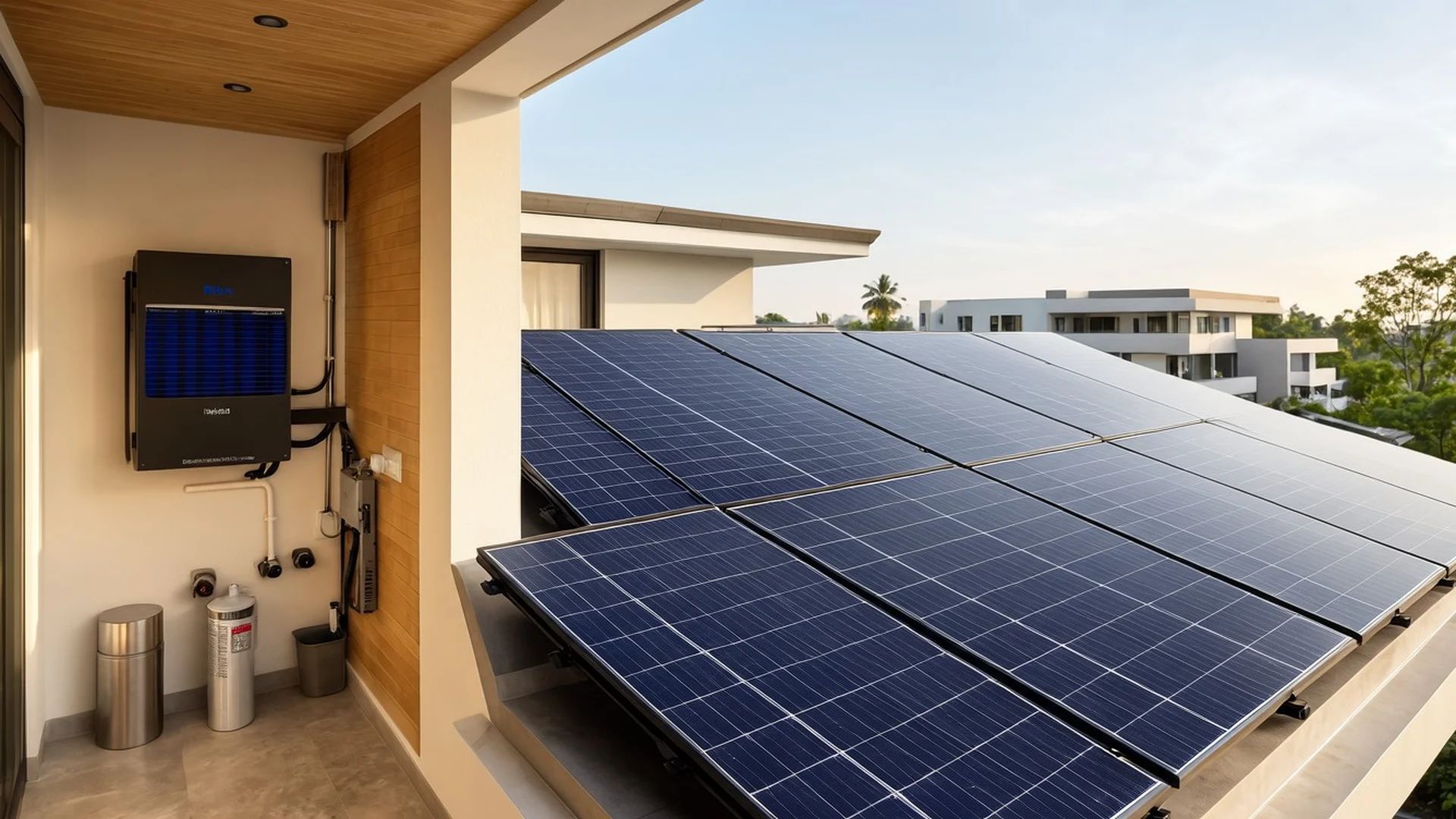
India's residential solar rollout has moved faster than almost any utility planner predicted.
According to live tracking on the PM Surya Ghar: Muft Bijli Yojana National Portal as of 19 November 2026, 92,33,775 applications have been filed, 57,97,343 rooftop installations completed, and 68,30,820 households benefited ahead of the current scheme window closing on 31 March 2027.
Yet that rapid success has created an awkward grid mismatch: most urban families are away at work or school when rooftop panels peak at noon, exporting surplus electricity into local transformers—and then drawing heavily from the grid after sunset. On 22 October 2026, independent energy think tank Ember quantified the dilemma in its policy study Plugging Storage into India's Rooftop Solar Revolution: adding a 5 kWh home battery to a standard 3 kW system slashes daytime grid exports by 85% to 90%, yet stretches household payback from 3.3 years to around 9 years.
As of 21 November 2026, decoding why batteries lose money under today's metering rules—how a 50% battery capex subsidy brings payback back down to 6.3 years (or 5.7 years with peak-tariff reform), and why crossing the ₹2 lakh solar loan threshold silently hikes interest from 6.00% to 8.15%—stops homeowners from overpaying for storage they do not yet need.
1. The Policy & Grid Context: Why Today's Grid Acts as a "Free Virtual Battery"
To understand why a ₹70,000–₹1,15,000 lithium battery pack destroys short-term payback for an urban homeowner, look at how India's net-metering settlement interacts with the Ministry of New and Renewable Energy's (MNRE) subsidy rules:
- Net Metering Pays Zero Rupees for Storing Daytime Power: Across most Indian states, residential net metering credits 1 unit (kWh) of solar electricity exported at noon strictly 1-to-1 against 1 unit consumed at 8:00 PM. As Ember's October 2026 analysis observes, the distribution grid effectively operates as a free, lossless virtual battery for the homeowner. Adding a physical 5 kWh battery shifts roughly 1,600 to 1,800 units per year from daytime export to evening self-consumption—delivering substantial congestion relief to local transformers and distribution companies (DISCOMs), while yielding zero incremental bill savings for the consumer (and actually sacrificing roughly 10% of shifted energy to battery charge/discharge conversion losses).
- Hybrid Systems Qualify for the ₹78,000 Solar Subsidy—Not a Battery Subsidy: MNRE clarified that grid-connected residential rooftop plants using BIS-certified hybrid inverters and battery storage remain fully eligible for PM Surya Ghar Central Financial Assistance (CFA)—₹30,000/kW up to 2 kW plus ₹18,000 for the 3rd kW, capped at ₹78,000 (with a 10% top-up in special-category states). However, the battery itself receives ₹0 in central subsidy, and off-grid solar systems remain completely ineligible. While MNRE's Innovative Projects window earmarks ₹500 crore for institutional and startup solar-plus-storage pilots, no "PM Surya Ghar 2.0" residential battery subsidy has been officially notified as of November 2026.
- Why State Grids Are Reaching a Tipping Point: By July 2026, India's rooftop solar capacity reached 30.7 GW (tripling from 6% of total solar capacity in FY19 to 19%), with 14.9 GW sitting on over 5 million residential roofs—nearly 88% concentrated in just ten states led by Gujarat (26% rooftop share) and Maharashtra (18%, versus 11% nationally). In Kerala, 2.3 GW of rooftop solar depresses noon demand while doing nothing to serve the state's 6.48 GW after-dark evening peak. That imbalance is precisely why policy analysts warn India will eventually pair storage incentives with tighter export rules—such as banking caps, net billing, or evening peak Time-of-Day (ToD) tariffs.
- The Hidden Post-October 2026 Solar Loan Cliff: Following the Reserve Bank of India's 7 October 2026 repo rate hike to 5.50%, public-sector banks reset concessional PM Surya Ghar loans effective 15 October 2026. Loans up to ₹2,00,000 (up to 3 kW) remain collateral-free at 6.00% p.a. floating (Repo + 0.50%, zero minimum CIBIL score, zero income proof, zero processing fee). The moment adding a battery pushes your loan even ₹1 above ₹2,00,000 (into the ₹2L–₹6L slab), the interest rate jumps +2.15 percentage points to 8.15% p.a. and triggers CIBIL (650+), net income (₹3 lakh+), PAN, and asset-insurance requirements.
2. Four 3 kW Residential Configurations (India, Nov 2026)
Not all storage setups cost or perform the same. Compare a standard on-grid plant against three battery-backed options before requesting vendor quotes:
| 3 kW System Configuration (BIS & DCR Compliant) | Indicative Gross Cost (Nov 2026) | Central CFA Subsidy (Current Rules) | Net Outlay Before Battery Subsidy | Everyday Utility & Backup Value | Simple Payback (1:1 Net Metering) |
|---|---|---|---|---|---|
| 1. 3 kW On-Grid Rooftop Solar (No Battery) | ₹1,65,000 (Market band ₹1.50L–₹2.20L) | ₹78,000 | ₹87,000 | Lowest cost, zero maintenance; shuts off automatically during grid outages (anti-islanding safety) | 3.3 years (OneMint calculation) |
| 2. 3 kW Hybrid + 5 kWh LFP Lithium Battery (No Battery Subsidy) | ₹3,05,000 (₹1.65L solar + ₹1.40L LFP pack, hybrid inverter, BMS & 18% GST) | ₹78,000 (₹0 on battery) | ₹2,27,000 | Cuts daytime exports 85%–90%; seamless backup for lights, fans, Wi-Fi & 1-ton AC for a few hours; 3,000–6,000 cycles | 9.0 years (OneMint calculation) |
| 3. 3 kW Hybrid + 5 kWh LFP With Proposed 50% Storage Subsidy | ₹3,05,000 | ₹1,48,000 (₹78k solar + ₹70k proposed storage) | ₹1,57,000 (OneMint calculation) | Same 85%–90% export reduction + full outage protection at roughly half the battery penalty | 6.2–6.3 years (5.7 yrs w/ ToD spread) |
| 4. 3 kW On-Grid + Separate Existing Home Inverter (Tubular Backup) | ₹1,65,000 + ₹35,000 (1.5 kVA inverter + 150 Ah tubular battery, if buying new) | ₹78,000 | ₹1,22,000 (₹87k if inverter already owned) | Keeps 3.3-year solar payback intact while preserving basic fan/light/Wi-Fi backup during urban cuts | 3.3–4.6 years (OneMint calculation) |
3. Worked Rupee Math: From 3.3 Years to 9.0 Years—and How a 50% Subsidy + Loan Discipline Change the Curve
To see exactly where every extra year of payback comes from, let us trace Ember's October 2026 baseline 3 kW + 5 kWh model alongside November 2026 Indian public-sector bank financing rates.
Block A: Cash Purchase Payback Across Four Policy Scenarios
Baseline Parameters & Assumptions (All Figures in INR):
- 3 kW On-Grid Rooftop System: Gross cost = ₹1,65,000; PM Surya Ghar CFA = ₹78,000; Net household outlay = ₹87,000.
- Annual Generation & Tariff Value: 4,056 kWh/year (approx. 338 units/month, squarely within India's 3,600–5,000 kWh/year 3 kW output band) valued at a blended urban domestic tariff of ₹6.50/kWh = ₹26,364/year in electricity bill savings.
- 5 kWh LFP Battery + Hybrid Inverter Upgrade: Incremental capex = ₹1,40,000 (covering a 5 kWh LiFePO₄ lithium pack listed around ₹70,000–₹1,15,000, hybrid inverter price premium over a standard on-grid inverter, DC switchgear, and 18% GST on standalone batteries) → Gross hybrid total = ₹3,05,000; Net outlay after ₹78,000 solar CFA = ₹2,27,000.
- Battery Energy Shifting & Conversion Loss: Shifts 1,700 kWh/year (midpoint of Ember's 1,600–1,800 kWh/year) from noon to evening at 90% round-trip efficiency → 170 kWh/year lost to charge/discharge heat (170 × ₹6.50 = ₹1,105/year lost under 1:1 net metering), yielding 1,530 net usable evening kWh/year.
- Tariff Reform Sensitivity (Scenario D): Illustrative ₹1.50/kWh evening peak vs. daytime export spread (via future Time-of-Day tariffs or net-billing export haircut) applied to the 1,530 usable evening kWh.
Formulas Used:
- Net Outlay = Gross System Capex − Solar CFA (₹78,000) − Proposed Battery Subsidy
- Annual Net Savings (1:1 Net Metering + Battery) = Base Solar Savings − (Shifted kWh × 10% Loss × Tariff)
- Simple Payback (Years) = Net Outlay ÷ Annual Net Savings
- Peak-Tariff Arbitrage Gain = Usable Shifted Evening kWh × Peak-vs-Daytime Spread (₹/kWh)
Line-by-Line Arithmetic:
- Scenario A — 3 kW On-Grid Solar Only (Current Rules):
- Net Outlay: ₹1,65,000 − ₹78,000 = ₹87,000.
- Simple Payback: ₹87,000 ÷ ₹26,364/year = 3.30 years (OneMint calculation).
- Scenario B — 3 kW + 5 kWh LFP Battery (Current Rules: ₹0 Battery Subsidy, 1:1 Net Metering):
- Net Outlay: ₹3,05,000 − ₹78,000 = ₹2,27,000 (+₹1,40,000 extra out of pocket) (OneMint calculation).
- Net Annual Savings (After ₹1,105 Round-Trip Loss): ₹26,364 − ₹1,105 = ₹25,259/year (OneMint calculation).
- Simple Payback: ₹2,27,000 ÷ ₹25,259 = 8.99 years (approx. 9.0 years) — stretching payback by +5.69 years (OneMint calculation).
- Scenario C — With Proposed 50% Storage Subsidy (₹70,000 Off Storage Capex, Still 1:1 Net Metering):
- Net Outlay: ₹2,27,000 − (50% × ₹1,40,000 = ₹70,000) = ₹1,57,000 (OneMint calculation).
- Simple Payback: ₹1,57,000 ÷ ₹25,259 = 6.22 years (aligning with Ember's 6.3 to 6.5 year benchmark; a smaller 25% subsidy of ₹35,000 trims net outlay to ₹1,92,000 and payback to 7.60 years) (OneMint calculation).
- Scenario D — 50% Storage Subsidy + ₹1.50/kWh Evening ToD / Net-Billing Spread:
- Annual Evening Arbitrage Saved: 1,530 usable kWh × ₹1.50 = +₹2,295/year (OneMint calculation).
- Revised Annual Net Savings: ₹25,259 + ₹2,295 = ₹27,554/year (OneMint calculation).
- Simple Payback: ₹1,57,000 ÷ ₹27,554 = 5.70 years (matching Ember's 5.7-year combined policy reform benchmark) (OneMint calculation).
Advertisement
Block B: The Hidden ₹2 Lakh Solar Loan Slab Penalty (Post-15 October 2026 Rates)
If a homeowner finances 90% of a ₹3,05,000 hybrid-plus-battery quote (₹2,74,500 loan) on a 10-year (120-EMI) public-sector solar loan instead of financing 90% of a ₹1,65,000 on-grid quote (₹1,48,500 or rounded ₹1,50,000 loan):
- On-Grid Loan (₹1,50,000 at 6.00% p.a. Concessional Slab, 120 EMIs): Monthly EMI = ₹1,665; total 10-year interest (before subsidy prepayment) = ₹49,837 (OneMint calculation).
- Hybrid + Battery Loan (₹2,74,500 Crossing ₹2L → Jumps to 8.15% p.a., 120 EMIs): Monthly EMI = ₹3,352; total 10-year interest = ₹1,27,769 (OneMint calculation).
- Pure Rate-Jump Tax (8.15% vs. 6.00% on the Exact Same ₹2,74,500 Loan): At 6.00%, total interest would be ₹91,202 — meaning crossing the ₹2 lakh slab adds ₹36,567 in pure rate-jump interest (before prepaying the ₹78,000 DBT subsidy) (OneMint calculation).
[!IMPORTANT] Variance Callout: Under current 1-to-1 net-metering rules, adding an unsubsidised 5 kWh battery to a 3 kW PM Surya Ghar system adds ₹1,40,000 upfront, loses ₹1,105/year to conversion losses, and stretches payback from 3.30 years to 8.99 years—while a 50% battery subsidy (₹70,000) cuts payback to 6.22 years (5.70 years with a ₹1.50/kWh evening tariff spread), and keeping any bank loan at or below ₹2,00,000 avoids a +215 bps interest-rate jump from 6.00% to 8.15% (OneMint calculation).
Note on Constants: Constants used are Ember's October 2026 ₹1,65,000 / ₹87,000 / ₹2,27,000 capex anchors, 4,056 kWh/yr generation at ₹6.50/kWh, 10% LFP round-trip loss, and 15 October 2026 public-sector bank Surya Ghar floating slabs linked to the 5.50% RBI repo rate. Residential CFA subsidies are capital grants and do not constitute taxable income under the Income Tax Act, 2025.
4. Battery Lifespan Traps & What We Don't Know Yet
Even if payback drops to 6.3 years with a future subsidy, two physical realities inside Indian homes can still bend your real-world return:
- Replacement Cycle vs. Payback Horizon: At one full charge-discharge cycle per day, a high-quality LiFePO₄ (LFP) battery rated for 6,000 cycles at 80% Depth of Discharge theoretically spans 16+ years—yet standard retail lithium warranties in India currently cover 5 to 10 years, and lower-tier 3,000-cycle packs last roughly 8.2 years. Meanwhile, conventional lead-acid tubular batteries (1,500 cycles, ₹18,000–₹23,400 per 12V unit) last only approx. 4 years of daily cycling and actually cost ₹8.12–₹8.33 per delivered kWh over their lifespan versus ₹2.84–₹7.57/kWh for LFP packs. Paying back an unsubsidised battery in 9.0 years when its warranty expires in Year 5 to Year 8 means the battery barely breaks even before needing replacement.
- The Unpriced Value of Outage Insurance: Pure payback spreadsheets value power backup during grid cuts at ₹0. For a Tier-2 or semi-urban household enduring 3 to 5 hours of daily summer outages—or a remote worker who loses billable income every time the power flickers—the reliability value of a hybrid battery can justify a longer financial payback even without a subsidy.
What We Don't Know Yet
- Whether MNRE Extends PM Surya Ghar Past 31 March 2027 With a Battery Subsidy: The National Portal currently displays 31 March 2027 as the active scheme closing date. Although media reports in July–September 2026 indicated MNRE discussed a potential next phase ("PM Surya Ghar 2.0") incorporating storage incentives, no official battery subsidy guideline, percentage, or launch date has been notified as of 21 November 2026.
- State Electricity Regulatory Commission (SERC) Shifts Away From 1:1 Net Metering: States with dense residential solar clusters—such as Gujarat, Maharashtra, and Kerala—are actively studying hybrid systems and settlement reforms. Whether residential net metering stays 1-to-1 for existing plants while shifting new 2027+ installations toward Time-of-Day net billing will determine how fast home batteries become financially self-sustaining.
5. What This Does NOT Mean
- It does NOT mean you should wait for an unannounced battery subsidy before installing rooftop solar: Delaying a 3 kW on-grid installation costs roughly ₹2,200 to ₹2,800 every single month in ongoing grid bills—and risks missing the current ₹78,000 subsidy window slated to run until 31 March 2027.
- It does NOT mean buying a hybrid inverter without a battery is always wasteful: If your neighbourhood suffers frequent outages or you plan to add an LFP battery once prices fall or a subsidy arrives, installing a battery-ready BIS-certified hybrid inverter today (paying roughly ₹15,000–₹20,000 more than an on-grid inverter) preserves future storage compatibility without locking ₹80,000+ into an unsubsidised battery immediately.
- It does NOT mean tubular lead-acid batteries are "cheaper" for daily solar cycling: Tubular packs carry a lower Day-1 invoice, but shorter cycle life (4 years vs. 8–16 years) makes them more expensive per kWh delivered than LFP lithium packs over a decade.
6. Actionable Step-by-Step Homeowner Audit: Deciding on Storage Before 31 March 2027
Before signing a vendor contract on pmsuryaghar.gov.in, run through this five-step checklist:
- Audit Your Real Outage Hours Over the Past 6 Months: Do not buy a ₹1.40 lakh battery upgrade to solve two 15-minute cuts a month. If you live in a reliable metro grid (Mumbai, Delhi, Bengaluru, Pune, Ahmedabad) and already own a ₹20,000 standard home inverter for Wi-Fi and fans, install a 3 kW on-grid system first and lock in the 3.3-year payback.
- Check Your State DISCOM's Exact Metering & Battery Rules: Confirm whether your DISCOM offers full 1-to-1 residential net metering for 3 kW systems and whether any state-level top-up subsidy (available in states like Uttar Pradesh and newly updated state schemes) stacks onto the ₹78,000 central CFA.
- Keep Any Bank Loan Strictly at or Below ₹2,00,000: If you choose a hybrid system costing ₹2.40 lakh to ₹3.05 lakh, pay the amount above ₹2,00,000 from household cash so your bank loan stays inside the 6.00% p.a. collateral-free slab rather than triggering the 8.15% p.a. rate across the entire principal—and immediately apply your ₹78,000 DBT subsidy credit toward principal prepayment (zero penalty). Model your loan EMI trade-offs using OneMint's Home Loan EMI Calculator and test your cash buffer via the Financial Health Quiz.
- Verify Mandatory Portal & Equipment Compliance Before Paying an Advance: Confirm your installer is active (not on the portal's "List of Deactivated Vendors"), your panels carry Domestic Content Requirement (DCR) certification (strictly mandatory with zero waiver), and your inverter carries BIS registration with IS 16169 anti-islanding protection. Also check the 3 September 2026 portal rule: if your application's portal confidence score falls below 70%, upload the signed prescribed undertaking and valid Government of India name proof promptly so subsidy redemption does not stall.
- Follow This Dual-Column Buying Verdict:
| Your Household Grid & Budget Situation | Best Move Before 31 March 2027 |
|---|---|
| Reliable Urban Grid (< 30 mins power cut/week) | Install 3 kW On-Grid (₹87k net) for a 3.3-year payback; keep your existing small inverter for occasional cuts and wait for storage prices or a notified battery subsidy. |
| Frequent Power Cuts (2+ hrs/day) OR Future ToD Prep | Install 3 kW Hybrid (battery-ready BIS inverter) + 5 kWh LFP battery only if outage backup matters to you; fund the excess over ₹2L in cash to keep the 6.00% loan rate. |
Related OneMint explainers: Your Next EMI Reset May Carry Two Rate Hikes, Not One, The Cheapest Month to Fly After the Festive Spike, and Onion Prices Fall by ₹15 a Kilo Every Harvest Season.
[!NOTE] Disclaimer: Educational content only. OneMint is not a SEBI-registered investment adviser. Nothing in this article constitutes equipment endorsement, architectural consultation, or credit underwriting advice. Solar equipment prices, DISCOM net-metering regulations, public bank loan terms, and central CFA rules change periodically; always verify final contract quotes and portal approvals before signing. For broader financial goal planning, try OneMint's interactive SIP Calculator and Financial Health Quiz.
Source List & Citations
- Ember (Energy Think Tank): Ruchita Shah, Plugging Storage into India's Rooftop Solar Revolution (published 22 October 2026) — 30.7 GW total rooftop solar (19% share), 14.9 GW PM Surya Ghar residential capacity, 3 kW on-grid (₹1,65,000 gross / ₹87,000 net / 3.3-year payback) vs. 3 kW + 5 kWh battery (₹2,27,000 / approx. 9-year payback / 85%–90% export reduction / 1,600–1,800 units shifted), and 50% battery subsidy payback impact (6.3–6.5 years; 5.7 years with tariff reform). URL: https://ember-energy.org/latest-insights/plugging-storage-into-indias-rooftop-solar-revolution/
- Ministry of New and Renewable Energy (MNRE), Government of India: PM Surya Ghar: Muft Bijli Yojana National Portal (pmsuryaghar.gov.in, achievement data as on 19 November 2026) — 92,33,775 applications, 57,97,343 RTS installations, 68,30,820 households benefited, 31 March 2027 closing date, ₹78,000 CFA cap, and 3 September 2026 <70% confidence-score undertaking notification. URL: https://pmsuryaghar.gov.in/
- Public-Sector Bank Solar Loan Rate Schedule (Effective 15 October 2026): Concessional PM Surya Ghar floating rate of 6.00% p.a. (Repo 5.50% + 0.50% / EBLR 8.15% − 2.15%) up to ₹2 lakh vs. 8.15% p.a. (EBLR + 0%) above ₹2 lakh up to ₹6 lakh, zero processing fee and zero prepayment penalty.
- Indian Solar Battery & 3 kW System Price Audits (September–November 2026): Live 4 November 2026 Indian LFP (4.8–5.12 kWh listed ₹67,700–₹1,15,000; 3,000–6,000 cycles) vs. tubular lead-acid (12V 150–200 Ah listed ₹17,999–₹23,399; 1,500 cycles) per-kWh delivered cost comparison and 18% standalone battery GST rules; 3 kW on-grid vs. hybrid component pricing bands.
Advertisement