

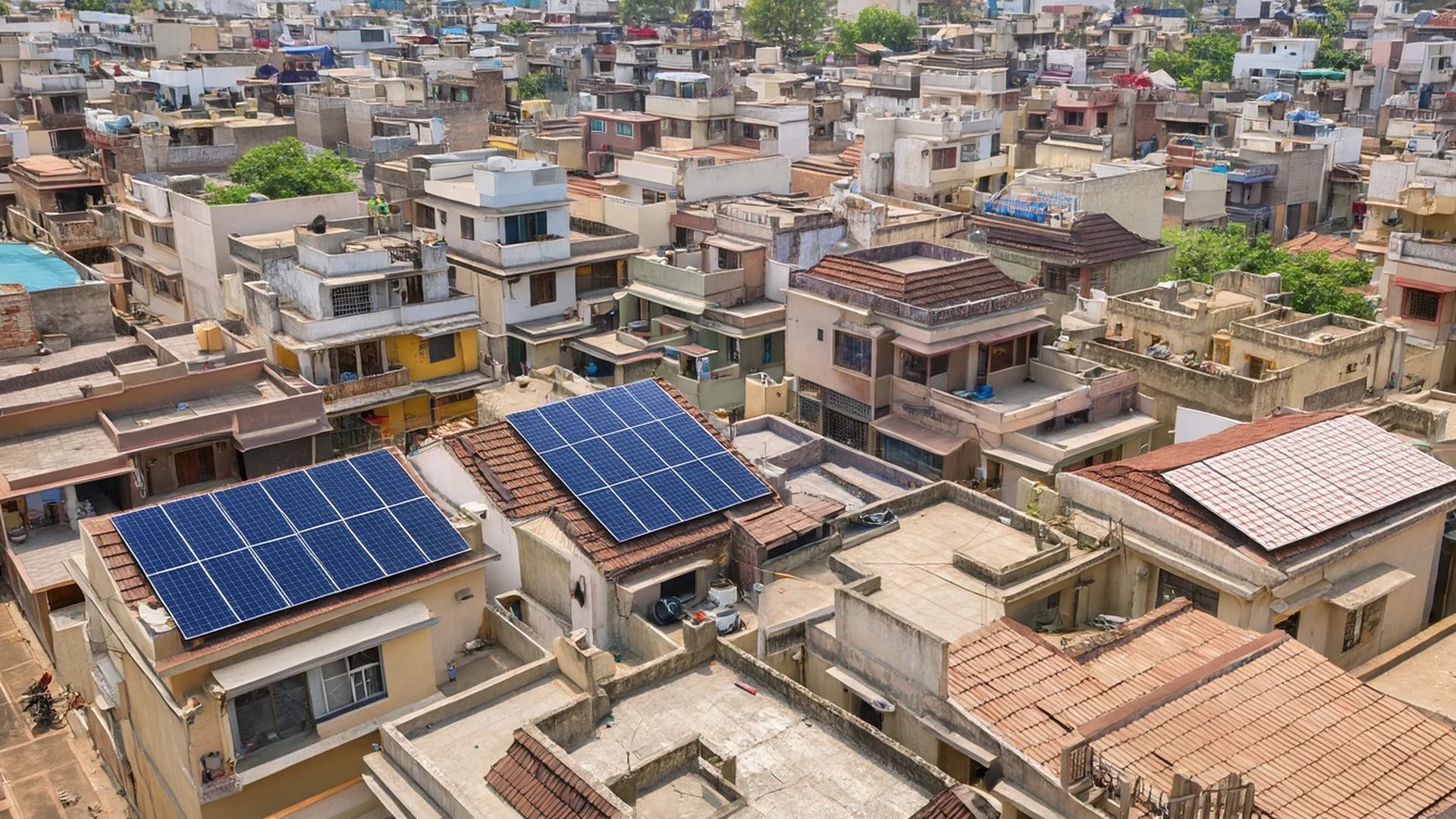
On paper, India's residential solar push looks unstoppable.
The PM Surya Ghar: Muft Bijli Yojana—offering up to ₹78,000 in Direct Benefit Transfer (DBT) subsidy for a 3 kW rooftop plant—had crossed 92 to 95 lakh consumer applications by mid-2026, with daily installation speeds tripling from 5,038 in October 2025 to over 16,300 per day by July 2026.
Yet zoom in on the funnel between registering interest and actually generating electricity, and a massive conversion gap appears.
Across the first half of 2026, only 23% to 28% of formal registrations had reached full commissioning (roughly 22 to 26 lakh systems in Q1 2026, climbing past 33 lakh in May and 40 lakh in June), and even as national installations accelerated toward the March 2027 deadline, the gap between top-performing states like Gujarat (38%–42% conversion) and laggard Tier-3 DISCOM states like Uttar Pradesh and Bihar (8%–10% conversion) remained four-to-one.
As of 21 November 2026, auditing portal rejection logs, DISCOM feasibility timelines, and EPC vendor activity reveals that India's rooftop solar bottleneck is no longer consumer awareness—it is five specific execution chokepoints that quietly cost stalled households ₹8,000 to ₹14,000 in lost bill savings and carrying costs.
1. The Policy & Ground Reality: Five Bottlenecks Behind the Conversion Gap
A household application on pmsuryaghar.gov.in must clear five sequential gates before a single rupee of subsidy lands in the bank: registration, DISCOM technical feasibility, vendor installation, DISCOM physical inspection and net-meter commissioning, and finally DBT e-token redemption.
While the central government processes DBT within 15 days of DISCOM approval, files stall sharply before that point for five concrete reasons:
- Preventable Consumer-Side Paperwork Rejections (approx. 18% Rejection Rate): Portal KPI tracking from June 2026 shows an approx. 18% national rejection rate, driven overwhelmingly by fixable household documentation mismatches rather than technical roof failures. Five errors account for nearly 90% of all rejections:
- Name mismatch between ID (Aadhaar) and electricity bill (approx. 34% of rejections)
- Sanctioned load smaller than the proposed solar system (approx. 19%)
- Inadequate property ownership proof (approx. 14%)
- Bank account details not matching the application (approx. 11%)
- Rejected geo-tagged roof photographs (approx. 9%)
- The Tier-1 vs. Tier-3 DISCOM Inspection Chokepoint: Even when paperwork is spotless, state electricity distribution companies (DISCOMs) operate at wildly different speeds. Under the Electricity (Rights of Consumers) Rules, 2020, residential applications up to 10 kW are supposed to receive deemed technical feasibility. In practice, Q2 2026 field data shows feasibility averaged 9 days in Gujarat (PGVCL/UGVCL) and 17 days in Rajasthan, but stretched to 31 days in Maharashtra (MSEDCL) and 47 days in Uttar Pradesh (PVVNL/MVVNL). Worse, inspection scheduling has become a separate queue: a single Junior Engineer (JE) in a UP or Bihar DISCOM circle can sit on 500+ pending PM Surya Ghar inspections alongside regular grid maintenance, pushing Tier-3 DISCOM median commissioning and disbursement to 95 days versus 30 days in Tier-1 DISCOMs.
- The "Ghost Vendor" Pool (Only approx. 40% of Registered EPCs Are Active): Homeowners browsing the national portal see tens of thousands of empanelled vendors and assume local supply is abundant. Yet MNRE mid-2026 data showed that out of roughly 70,000 to 75,000 registered EPCs, only 25,000 to 30,000 (approx. 40%) had completed even a single installation in the preceding six months—and 22% to 25% of all active installers were concentrated in Gujarat alone. In smaller towns across UP, Bihar, Odisha, and the North East, small EPCs face severe working-capital crunches when DISCOM approvals drag past 90 days, causing them to abandon slow leads.
- DCR Module Supply & The Year-End ALMM List-II Rush: Under PM Surya Ghar, the Domestic Content Requirement (DCR)—requiring both solar panels and the photovoltaic cells inside them to be manufactured in India—is absolute, with zero waiver. Submitting mismatched panel serial numbers or non-DCR modules forfeits the entire ₹78,000 subsidy. Adding to late-2026 pressure, MNRE's ALMM List-II domestic cell mandate takes full effect on 1 January 2027 for all grid-connected commercial and net-metered projects, triggering a year-end rush by commercial and industrial (C&I) buyers that is crowding the exact same EPC crews and DISCOM net-metering queues.
- The Upfront Cash Gap (62% Still Self-Finance): Because the ₹78,000 subsidy arrives only after commissioning, a household installing a 3 kW plant must fund ₹1,65,000 to ₹1,75,000 upfront. Mid-2026 market data shows 62% of installing households still pay out of pocket while only 38% use concessional bank loans—leaving millions of speculative registrants who clicked "Register" without ₹1.75 lakh in liquid cash stuck permanently at Gate 1.
2. The Bottleneck & State-Speed Split Table (India, 2026 Benchmarks)
Before blaming "the government portal," map your exact state and application stage against 2026 ground-level timelines:
| Bottleneck Stage | Tier-1 DISCOMs (e.g., Gujarat, Parts of Rajasthan/Kerala) | Tier-3 / Slower DISCOMs (e.g., UP, Bihar, Parts of Maharashtra/Odisha) | Primary Cause of Stall | How a Homeowner Breaks the Logjam |
|---|---|---|---|---|
| Gate 1: Registration & Document Match | 1–3 days (if pre-audited) | 15–30 days lost per rejection loop | approx. 34% ID-bill name mismatch; approx. 19% low sanctioned load | Fix utility-bill name & sanctioned load before applying on the portal. |
| Gate 2: DISCOM Technical Feasibility | 9–17 days | 31–47 days | Manual circle-level sign-offs despite deemed-feasibility rules | Track weekly via consumer login; escalate past 15 days on portal grievance desk. |
| Gate 3: Active EPC & DCR Panel Supply | 7–14 days (high EPC density) | 20–45 days (thin active vendor base) | Only approx. 40% of registered EPCs are active; DCR cell tightness | Verify vendor's last 6-month installation count & DCR serial-number invoice upfront. |
| Gate 4: Physical Inspection & Net Meter | 10–15 days | 30–50+ days | JE backlog (500+ pending files/circle) & smart-meter stockouts | File inspection request the same day mounting finishes; hold 20% vendor payment. |
| Gate 5: DBT Subsidy Disbursement | approx. 30 days total median | approx. 95 days total median | Aadhaar–bank seeding errors (approx. 11% rejections) | Run the portal's built-in Aadhaar–bank seeding self-check widget before redeeming. |

3. Worked Rupee Math: What a 95-Day Bottleneck + One Rejection Actually Costs a 3 kW Household
Most homeowners treat a three-month DISCOM delay as a mild annoyance rather than a rupee loss. In reality, every month your paid-for 3 kW plant sits idle waiting for a net meter—or gets kicked back by a preventable paperwork rejection—burns real post-tax cash in foregone electricity savings and locked-up capital.
Baseline Parameters & Assumptions (November 2026 India Benchmarks, All Figures in INR)
- 3 kW On-Grid Rooftop System Cost: ₹1,75,000 gross; ₹78,000 PM Surya Ghar CFA subsidy; ₹97,000 net cost after DBT.
- Monthly Solar Generation & Tariff Offset: 350 units/month (4,200 kWh/year) × ₹7.50/kWh retail domestic energy tariff = ₹2,625/month (₹87.50/day) in bill savings.
- Opportunity / Financing Cost on Blocked Capital: 7.00% p.a. (representing either foregone FD interest on ₹1,75,000 cash paid upfront or concessional solar loan interest during the idle wait).
- Scenario A — Fast Tier-1 DISCOM (Zero Rejections, 30-Day Commissioning & DBT Median): Only 15 idle days between hardware payment and net-meter commissioning; 30 days total to DBT credit.
- Scenario B — Slow Tier-3 DISCOM (95-Day Commissioning & DBT Median, Clean Paperwork): 75 idle days between hardware payment and net-meter commissioning; 95 days total to DBT credit.
- Scenario C — Slow Tier-3 DISCOM + 1 Preventable Paperwork Rejection (+30 Days Added = 125 Days Total): 105 idle days post-payment + ₹1,500 in local bill-correction/load-upgrade re-submission trips.
Plain-Text Formulas Used
- Foregone Solar Bill Savings = Idle Days Post-Payment × (₹2,625 ÷ 30 Days)
- Carrying Cost on Full ₹1,75,000 (Until Net Meter) = ₹1,75,000 × 7.00% × (Idle Days ÷ 365)
- Extra Carrying Cost on ₹78,000 Pending DBT (Post-Meter to Payout) = ₹78,000 × 7.00% × (DBT Wait Days ÷ 365)
- Total Bottleneck Cost = Foregone Savings + Carrying Cost + Extra Re-Submission Spend
Line-by-Line Arithmetic
Scenario A — Fast Tier-1 DISCOM (30-Day Median: 15 Idle Days + 15 DBT Days)
- Foregone Solar Savings (15 days): 15 × ₹87.50 = ₹1,313 (OneMint calculation).
- Carrying Cost on ₹1,75,000 (15 days) + ₹78,000 (15 days): ₹503 + ₹224 = ₹727 (OneMint calculation).
- Total Tier-1 Friction Cost: ₹1,313 + ₹727 = ₹2,040 (OneMint calculation).
Advertisement
Scenario B — Slow Tier-3 DISCOM (95-Day Median: 75 Idle Days + 20 DBT Days)
- Foregone Solar Savings (75 days): 75 × ₹87.50 = ₹6,563 (OneMint calculation).
- Carrying Cost on ₹1,75,000 (75 days) + ₹78,000 (20 days): ₹2,517 + ₹299 = ₹2,816 (OneMint calculation).
- Total Tier-3 Friction Cost: ₹6,563 + ₹2,816 = ₹9,379 — ₹7,339 higher than a Tier-1 DISCOM (OneMint calculation).
Scenario C — Slow Tier-3 DISCOM + 1 Preventable Name/Load Rejection (125 Days: 105 Idle Days + 20 DBT Days)
- Foregone Solar Savings (105 days): 105 × ₹87.50 = ₹9,188 (OneMint calculation).
- Carrying Cost on ₹1,75,000 (105 days) + ₹78,000 (20 days): ₹3,524 + ₹299 = ₹3,823 (OneMint calculation).
- Re-Submission & Local DISCOM Visits: ₹1,500.
- Total Stalled-File Cost: ₹9,188 + ₹3,823 + ₹1,500 = ₹14,511 — wiping out 18.6% of the ₹78,000 central subsidy in pure deadweight delay (OneMint calculation).
[!IMPORTANT] Variance Callout: Moving from a fast 30-day Tier-1 DISCOM (₹2,040 friction) to a 95-day Tier-3 DISCOM (₹9,379) plus a single preventable name or load rejection (₹14,511) costs a 3 kW homeowner ₹12,471 in avoidable lost savings and carrying costs—erasing nearly one-fifth (18.6%) of the ₹78,000 subsidy before the meter even spins backward (OneMint calculation).
Note on Constants: Constants used are ₹1,75,000 gross 3 kW cost, ₹2,625/month solar offset at ₹7.50/kWh, 7.00% p.a. opportunity/loan cost, and 2026 Tier-1 vs. Tier-3 DISCOM median timelines. For the full lifecycle hidden-cost breakdown including Year-10 inverter replacement, see OneMint's The 3 kW Rooftop Solar Subsidy (Up to ₹78,000): What the Vendor Won't Quote.
4. Why "1 Crore Registrations" Looks Worse Than Reality & What We Don't Know Yet
Evaluating the conversion gap fairly requires separating true execution bottlenecks from noisy registration counts:
- Speculative Registrations Inflate the Denominator: Because registering on pmsuryaghar.gov.in is free and takes five minutes with a mobile number and consumer ID, millions of households—including apartment tenants with no roof rights, homeowners with heavily shaded terraces, and families simply checking eligibility—created portal accounts without intending to install immediately. Measuring installations against feasibility-cleared applications yields a much healthier conversion rate than measuring against raw portal sign-ups.
- National Speed Has Improved Dramatically Since 2024: It is equally important not to paint the scheme as frozen. National median disbursement time fell by half—from approx. 130 days in Q1 FY25 to approx. 65 days by Q3 FY26—and MNRE rolled out practical portal fixes in mid-2026, including a built-in Aadhaar–bank seeding self-check widget, a 5 MB document upload limit, simplified Group Housing Society (RWA) flows, and the Utility-Linked Aggregation (ULA) model to help underserved households.
What We Don't Know Yet
- Whether MNRE Extends the 31 March 2027 Deadline: In September 2026, MNRE indicated it expected to cross 90 lakh households by March 2027 and was considering a three-to-four-month extension (alongside stakeholder consultations for a successor scheme) if needed to hit the 1-crore mark. Until a formal extension order is notified, households should still treat 31 March 2027 as the hard cut-off.
- Impact of the 1 January 2027 ALMM List-II Mandate on Retail Panel Prices: Once all non-subsidised net-metered projects must also use domestic cells from 1 January 2027, whether domestic cell capacity keeps pace or temporarily tightens 3 kW DCR module prices in Q4 FY27 remains an active market risk.
5. What This Does NOT Mean
- It does NOT mean you should wait until 2027 for DISCOM queues to clear: Waiting out a 60-day queue by delaying your application for 6 months simply guarantees 6 months of full electricity bills (₹15,750+ lost) and puts you into the final pre-March 2027 rush.
- It does NOT mean paying a "middleman" speeds up the national portal: Every stage—feasibility, vendor selection, inspection upload, and e-token redemption—is logged digitally under your consumer login. Unofficial agents cannot bypass UIDAI bank-seeding or DCR serial-number checks.
- It does NOT mean apartment (RWA) residents are locked out: Group Housing Societies can apply for common-area rooftop solar under simplified 2026 RWA flows (receiving ₹18,000/kW up to 500 kW for common facilities), even if individual flat owners lack private terrace title.
6. Actionable Step-by-Step Homeowner Audit: Clear All Five Gates on the First Try
Use this five-step pre-flight checklist before clicking Submit on pmsuryaghar.gov.in so your file never lands in the 18% rejection pile:
- Run the 3-Document Exact-Match Audit (Eliminates 64% of All Rejections): Before registering, place your latest electricity bill, government ID, and bank passbook/cancelled cheque side by side. Verify that the consumer name spelling matches across all three, confirm your sanctioned load is at least equal to your planned kW size (upgrade load with your DISCOM first if not), and run the portal's Aadhaar–bank seeding self-check widget to confirm your bank account is DBT-enabled.
- Vet Your Vendor's Active Track Record—Not Just Portal Listing: Because 60% of registered EPCs are inactive, pick an empanelled vendor who can show at least 10 commissioned PM Surya Ghar installations in your exact DISCOM circle over the past 6 months, and confirm in writing that they have ALMM-listed DCR modules in stock right now.
- Use the 6.00% Concessional Loan If Cash Is Tight (Keep It ≤ ₹2 Lakh): Do not stall at Gate 1 waiting to save ₹1.75 lakh in cash. If your system is 3 kW or below, public-sector banks offer collateral-free PM Surya Ghar loans up to ₹2,00,000 at 6.00% p.a. (zero processing fee, zero prepayment penalty—see OneMint's PM Surya Ghar Battery Maths). Prepay ₹78,000 the week your DBT lands, and model your EMI on OneMint's Home Loan EMI Calculator.
- Trigger the Inspection Clock on Installation Day: The exact day your vendor finishes mounting panels and uploads geo-tagged photos, log into your consumer account to verify the upload and submit the DISCOM inspection request immediately—never wait weeks for the vendor's back office. Hold back 20% of the vendor's payment until the bidirectional net meter is physically installed and approved.
- Escalate Past 15 Days Using Formal Portal Channels: If DISCOM inspection or feasibility stalls beyond 15–21 days without a written objection, log a formal grievance on the PM Surya Ghar national portal (which carries a 30-day resolution SLA) or your state DISCOM's Consumer Grievance Redressal Forum (CGRF). Pair this with OneMint's Financial Health Quiz to plan your household utility budget cleanly.
Related OneMint explainers: The 3 kW Rooftop Solar Subsidy (Up to ₹78,000): What the Vendor Won't Quote, PM Surya Ghar Battery Maths: Why Adding Storage Stretches Payback From 3.3 to 9 Years, and After the First Rate Hike in Nearly Four Years: A Four-Rung FD Ladder.
[!NOTE] Disclaimer: Educational content only. OneMint is not a SEBI-registered investment adviser. Nothing in this article constitutes equipment endorsement, architectural consultation, or credit underwriting advice. Solar equipment prices, DISCOM net-metering regulations, public bank loan terms, and central CFA rules change periodically; always verify final contract quotes and portal approvals before signing. For broader financial goal planning, try OneMint's interactive SIP Calculator and Financial Health Quiz.
Source List & Citations
- Ministry of New and Renewable Energy (MNRE) & Press Information Bureau (PIB): Release ID 2268992 (4 June 2026) (pib.gov.in) — 40 lakh milestone, 65 lakh+ active pipeline, 75 lakh December 2026 target, and Utility-Linked Aggregation (ULA) model; PM Surya Ghar National Portal (pmsuryaghar.gov.in) — ₹78,000 CFA cap, 15-day post-DISCOM DBT SLA, and DCR mandate. URL: https://pmsuryaghar.gov.in/
- PM Surya Ghar 2026 Conversion & DISCOM KPI Audits: PM Surya Ghar Trends and Numbers 2026 (quickestimate.co) — 92–95 lakh registrations vs. 22–26 lakh Q1 2026 commissioned (approx. 23%–28% conversion), Gujarat (38%–42%) vs. UP (8%–10%), 65-day national median (30 days Tier-1 vs. 95 days Tier-3), Q2 2026 feasibility times (9–47 days), 40% active EPC ratio, and 38% loan vs. 62% self-financed split.
- June 2026 Portal Rejection & Policy Tracker: PM Surya Ghar Monthly Update June 2026 (heavengreenenergy.com) — approx. 18% rejection rate breakdown (34% name mismatch, 19% sanctioned load, 14% ownership, 11% bank mismatch, 9% roof photo) and Aadhaar–bank seeding self-check rollout.
- Saur Energy International (13 November 2026) & Solar Ladder (26 August 2026): 175 GW Solar Done, India Now Eyes Floating Solar with Storage and 1 Crore Rooftops (16,328 daily installations in July 2026, 29,469 active vendors, potential 3–4 month post-March 2027 extension) and New DCR Solar Panel Rules in India 2026 (1 January 2027 ALMM List-II domestic cell deadline).
Advertisement